Aseres Hadibros Aliya

There is a saying, “whatever goes around comes around”. For better or for worse, life eventually catches up with everyone. Sometimes it happens sooner and sometimes it happens later, but eventually Hashem serves everyone the same portion they served others. For the most part, life has a way of keeping track and we experience it according to our prior actions. By Hashem, no good deed goes unrewarded and no bad deed is unaccounted for. Simply put, Hashem runs His world מדה כנגד מדה.

It became my custom after the passing of my father, to try and acquire מפטיר & מוסף on the Yom Tov day יזכור was recited, as a zechus.

One year, right before it was time to be called up for מפטיר, the Gabbi approached me and said, “I know you bought מפטיר and it belongs to you, but there is a guest in Shul, an old Jew, who very much wants מפטיר. Would you forfeit the Aliyah?” That was not an easy decision to make.The only reason I bought מפטיר in the first place, was to honor the memory of my father. What right did I now have to give it up. Wouldn’t that be a dishonor? So I went over to the Rov and asked him what to do. He thought for a moment and said, “if you give up the מפטיר, the joy you will bring this old Jew will be so significant, that the merit your father will receive from your act of חסד, will be greater than if you took the מפטיר for yourself.” I humbled myself, accepted the Rov’s decision and forfeited the Aliyah. As hard as it was, it was even harder to pay for the מפטיר I never received.
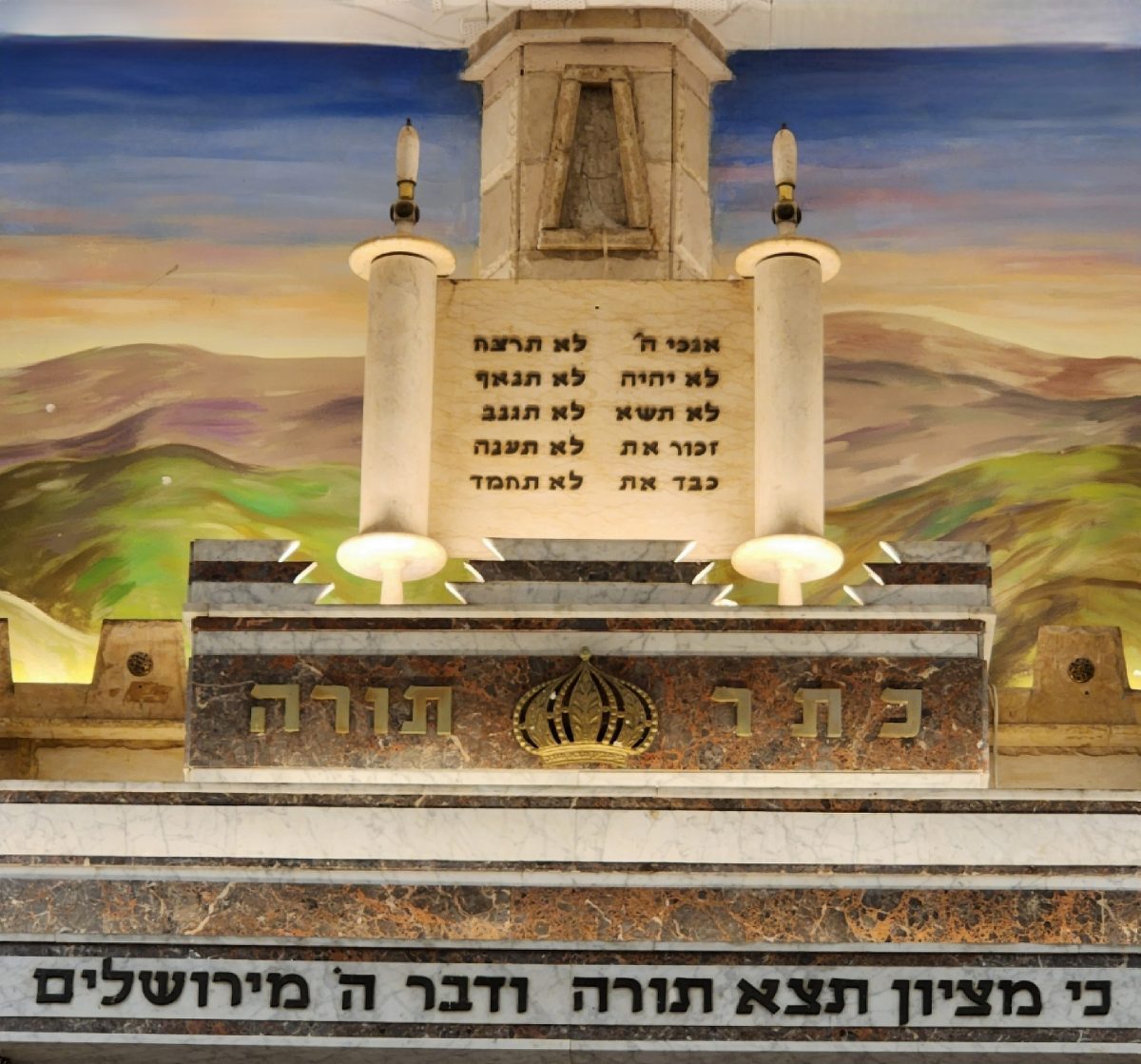
Now turn the clock ahead 35 years. The Yom Tov of Shovuos had arrived. A small Minyin gathered in one of the Enclave  homes in Lakewood where I resided at the time. As is customary right before Kereyas HaTorah, the Gabbi sells the Ahleyos. I decided to buy Aseres Hadibros and joined the bidding process. Out of the corner of my eye I noticed, that there was only one more person bidding against me, which happened to be a good friend of mine. Was very uncomfortable, trying to outbid him, so I just backed off and let him win the Aliyah. What I did, did not go unnoticed. When the time came for the Aseres Hadibros to be read, my friend forfeited the Aliyah he bought and told the Gabbi to give it to me. He noticed that I really wanted the Aliyah and that I backed down only because I didnt want to interfere with his will to buy it. What a true friendship. I didn’t want to take it away from him and he didn’t want to take it away from me. No doubt after the Aliyah I asked the Gabbi to make a מי שברך accompanied by a contribution in his honor.
The מפטיר I paid for and gave up 35 years earlier now came back to me, with my friend giving up his Aliyah that he paid for and giving it to me. We have a dictom אין הקב”ה מקפח שכר כל בריא. Hashem keeps track and rewards everyone justly, at the right time. Sometimes it takes time, a lot of time, before Hashem pays a Jew back for a positive action he did, but nothing is ever forgotten. When you see it play itself out, it is a humbling experience. You never lose, when you do the right thing. It always comes back to you or to your children, in one way or another. The main thing is to try to do the next right thing, no matter what anyone else is or is not doing. We worship Hashem, no one else and nothing else.

Naming My Daughter

Hashem has an interesting way of orchestrating events. When He gives us the opportunity to look back in time, we may find them quite amusing.

Some years passed before Hashem blessed my wife and I with our first child. One Erev Shabbos Kodesh, right before candle lighting, a beautiful, healthy, baby girl was born to us. The excitement and simcha our families experienced that Shabbos was indescribable.

At the time, I lived in Borough Park and davened in the Lakewood Minyin on 16th Avenue. Shabbos morning,  I informed the Gabbi Rabbi Kushner about the Simcha and asked him to please give me an Aliyah. The פרשה being read that week was וילך in חומש דברים. Customarily, a person who is making a simcha, or is giving a newborn a name, is called up to the third or sixth Torah portion being read, שלישי or ששי. For some unknown reason, the Gabbi chose to call me up for חמישי, the fifth portion.
After the Aliyah, the מי שברך for naming a baby was recited by the Gabbi, at which time I named my daughter, אסתר גרינא.
Shortly thereafter, a gentleman approached me and asked,
“Do you realize the significance of the specific Aliya you were given? You named your daughter Esther and the Talmud asks, אסתר מין התורה מנין?
Where is Esther hinted to in the Torah and answers,  שנאמר  “ואנכי הסתר אסתיר פני”.
It happens to be, the Gabbi gave you the Aliyah where Esther’s name is alluded to”. Unbelievable. He didn’t even know beforehand, what name I was going to give.Think its a coincidence? No way. Truth be told, Hashem knew what name I was going to give. He inspired the Gabbi to specifically call me up for חמישי, in order to sync the name, with the Aliyah I received.
If that was not enough, after מוסף another gentleman approached me and said. “Its not by coincidence that you added a second name גרינא”. He went on to explain, that the Talmud in מסכת מגילה looks for the best way to describe Esther and says, “אסתר יראקרקות היתה” “Esther was a גרינא”, as translated into Yiddish. Since it was an uncommon name, we were unsure if to add it as a second name or not. At the end, it was added to perpetuate the memory of my aunt, who was murdered  in the Holocust, during the Nazi invasion of Poland. By being introduced to this גמרה, it became clear, that adding this second name was ordained by Hashem. The two names given to my daughter that Shabbos, אסתר גרינא matched perfectly.
Those two gentleman who came over to wish Mazel Tov and share their knowledge, made all the difference. It now was clear that conception of this name and when it was given, came from a higher realm.
The story doesn’t end there.  Twenty years later my oldest daughter wound up marrying the youngest son of Rabbi Kushner the Gabbi, who gave his future daughter in law her name twenty years earlier. Sometimes we say, Hashem has a sense of humor. Its true. What aliyah I received then, what name I gave my daughter, the Gabbi who gave the name, was all part of Hashem’s master plan. Many times we experience events but only understand them later on.
Looking back, we come to understand how all the peices of the puzzle fit perfectly. Simply said, Hashem runs His world perfectly, to the finest detail. Let us not for one moment think, that we are an insignificant detail in Hashem’s master plan. We may be a detail, but a very important one to Hashem.

LOOKING FOR A ZECHUS

Looking for a ZECHUS was my father’s essence. Again and again, no matter what happened, he was always looking for a ZECHUS.
He embodied and lived the lesson Chazal taught us, “תן בלבנו, שנראה, מעלות חברנו  ולא חסרונן”
“Hashem, have our hearts perceive, the merits of our friends and not their failures”.
In the home I grew up, it was common place for my mother to always say, “Daddy is already looking for a Zechus”. Whenever a situation arose, where someone could possibly be blamed, my father would immediately figure out some kind of reason, how to justify a behavior and how to excuse the person supposedly at fault. Then he said in Yiddish, “פארקיק מאן קינד, פארקיק”
 “Overlook my child, overlook” There are two ways to view every incident, either positively or negatively. It is our choice to pardon, or condemn. To forgive or carry a grudge. To aggravate a situation, or calm it down, by overlooking. We need to ask ourselves, what lifetime goal,  we wish to pursue. Do we want to enhance peace, or increase strife, whenever challenged? It is interesting to note, that much of what we experience
in life relationships, is dependent on our perception and reaction. We need to truthfully ask ourselves, why we find it so difficult sometimes to give someone else, the benefit of the doubt? Is it about our pride? Let’s be real. If we were more humble, would we pay much attention to every infraction we are faced with?
At the end of the day, our stature in life is not raised by putting others down. On the contrary, it is only by building others up and finding a ZECHUS for them, that we merit Hashem’s blessings. We only build a happy cohesive family and society through kindness, forgiveness and understanding. When we emulate Hashem’s ways and search for a ZECHUS, for the people around us, then when we mess up, Hashem also gives us the benifit of the doubt. Our main goal must always be to create peace and harmony, at home, in Shul and in all our other relationships. Want a Zechus, find a Zechus.

Shoeshine Encounter

Was scheduled for an important meeting out of state. Woke up bright and early one morning, quickly davened with a Minyin, grabbed a bite and headed to the airport.

After check in, I noticed that my shoes were unpolished. Being presentable when meeting business people, especially those unfamiliar with our culture is important. As the saying goes, “a first impression is a lasting impression.” Out of the corner of my eye, I noticed a shoe shine stand. Quickly approached it and asked the Hippie operating the stand for a shine. He got straight to work, eyeing me all the time. After he finished, I thanked him, stepped down, payed, tipped and started on my way. All of a sudden he stopped me and said, “Rabbi, may I ask you a question?” “Sure”, I replied.

“Tell me, why do some Jews dip their fingers into the wine plate Saturday night and put wine droplets on their eyes, behind their ears and in their pockets?” Was stunned to have such an odd question presented to me by a shoe shine man, who hardly looked Jewish, was dressed as a Hippie, long hair, beads and all. Obviously, I whispered to myself, there probably is a lot more to this story then meets the eye. Feeling that my answer might have important ramifications for the man in the future, I silently asked Hashem to please provide for me an answer, that would touch the heart of this seemingly lost Jewish soul.

I said to him, “the ceremony at which these acts are performed is called Havdolah, which means separation. It’s a solemn time, when Jews seperate from the holiness and tranquility of the Shabbos and get ready to enter the mundane weekday world. At that time, we are reminded to take along with us the sanctity and inspiration of the past Shabbos, to insure that it lasts throughout the upcoming week, till the following Shabbos arrives. As a reminder, we place some droplets of wine on our eyes, to remind us to only look where it’s proper to look and to refrain from looking where it is improper to look. We place some droplets of wine behind our ears, to remind us to only hear what is proper to hear and to refrain from hearing what is improper. We put some wine which symbolizes happiness and prosperity into our pockets, as a good omen, that all our business dealings be blessed the following week.
The Havdolah ceremony also reminds us, that we must live on a higher level then the other nations of the world and conduct all our dealings according to Torah Law. Not to heaven forbid desecrate God’s Holy Name, who’s banner we Jews carry. That we are different and have an obligation, when we are out of the sanctity of the Shabbos to maintain ourselves appropriately. Not to look like them, not to think like them, not to talk like them, not to hear like them, and not to see like them. To behave like a Jew and sanctify God’s name wherever we may find ourselves.”
Why I had to be there at that exact time and at that specific place, I will never know. No doubt, Hashem sent me there that morning, for him to hear this message. Perhaps he happened to remember something he saw in his past that intrigued and puzzled him. Now the question he had been carrying around, had an answer that may have been the fuel Hashem sent, to energize his Jewish spirit and send him on a search of his Jewish heritage.
In שיר השירים  we read          “קול דודי דופק.” Sometimes Hashem who is referred to as דודי, my beloved, comes knocking on the door of a Jewish heart, to wake up the sleeping spirit of his soul.
We never know why we are, where we are. Why certain people cross our path in life unexpectedly. Maybe Hashem sent us as a trigger, to inspire them to learn from us, by the example we portray and live. Therefore, it is important to be cognizant of our actions everywhere, all the time, for one can never know what example he is publicizing that may be scorned or emulated. May it be that we merit to be a positive influence in the life of all those we meet.

Forget The KING?

In the late sixties I studied in the famous Telz Yeshiva in Wickliffe, Ohio. At that time,  the renowned Roshei Hayeshiva, Horav Mordechi Gifter z”l and Horav Boruch Sorotzkin z”l graced this Torah Academy with their leadership.
There was one particular lesson that I will never forget .
It was Elul and the Rosh Hayeshiva Rav Gifter gave a Shuir Daas. Everyone in the Yeshiva and Kollel was required to attend. The purpose was to prepare the entire student body for the Yomim Noroyim. How we were to view that awesome time and take advantage of those special days. To appreciate it’s significance through exemplary behavior and positive action.
Rav Gifter was a very dynamic speaker, who always captivated audiences with his profound messages.
The Beis Medresh was filled to capacity.The Rosh Hayeshiva began his lecture and throughout you could not hear a pin drop. Towards the end, the Rosh Hayeshiva posed the following question. Why is it, that during the Aseres Yemei Teshuva, the Ten days of Repentance between Rosh Hashona and Yom Kippur, if one forgot to add the additional special prayers recited during Shmonei Esrei, he is not required to go back to the beginning? If one however forgot to say HAMELECH Hakadosh, Holy KING and instead said Holy G-D, the Halocho requires that he start over from the beginning?
The Rosh Hayeshiva then remained silent, as he allowed everyone time to mull over the question and come up with an answer. Time stopped, as everyone waited with anticipation.
Then the Rosh Hayeshiva powerfully answered, with a heart wrenching question.
וואס היסט מען פארגעסט פון מלך
“How is it ever possible for a Jew to forget about his KING”? The Rosh Hayeshiva then returned to his seat without another word. His sharp, abrupt message was clear and to the point. There was nothing more to add. A Jew must ALWAYS remember, that he is ALWAYS
in the presence of the KING. Those powerful words left an everlasting impression on the heartstrings of all students. They seeped into everyone’s being and embedded themselves in the consciousness of all listeners.Truthfully speaking, how could a Jew ever forget about his KING, even momentarily? Isn’t it inconceivable, to be speaking to the KING and at the same time forgetting about Him? If by chance one did, he needs to retrace his steps and start over from the beginning. Its apparent he wasn’t speaking to the KING in the first place. Once again he must take stock and become cognizant of Hashem’s presence. If one forgot about his personal requests and needs during  prayers, that’s not the end of the world. To forget about the KING, that’s a whole other story.
If only we were able to live our lives, constantly cognizant of Hashem’s presence, everywhere, all the time, no matter where we are. What an uplifting life we would lead.

No doubt the Rosh Hayeshiva lived his life that way. Bounded to his Creator, serving him happily and faithully with love and admiration daily. The KING was ever present in his conscience. May we only merit to serve Hashem that way.

My Prayers Can’t Go Up

This unforgettable experience is cause for reflection. At least it was for me. So I called up  Rabbi Pesach Krohn and shared the following story with him. He was inspired and told me he would incorporate it into one of his lectures on Tefillah.
One morning, I happened to wind up davening Shacris in one of the large prominent Shuls in Brooklyn. Unfortunately it looked more like a marketplace then a Shul, begging for מורא מקדש. Found it difficult to concentrate, let alone hear the Chazan.
A loud commotion suddenly arose from the center of the Shul. An elderly man had gotten up from his seat and started screaming loudly, “quiet, quiet, quiet. My wife is in the hospital dying and your commotion and disrespect, is not allowing my Tefillos to go up to Hashem. I will hold you all responsible for anything that happens to her”.
Everyone stopped cold in their tracks and were taken aback by his heart wrenching words. That unexpected outburst quieted things down and allowed davening to resume. Rest assured, things were not the same after that.
Personally, I was gratified to have witnessed a real Jew in action. Not intimidated and afraid of no one, but Hashem. In the depths of his heart, he truly felt, that his prayers to Hashem, had the power to make a difference. He was so connected to Hashem and convinced, that his wife’s recovery actually depended on his prayers. He hadn’t come to Shul that morning just to daven, pay his respects, mumble some words, speak to some friends and take off. He was earnest and sincere about in who’s presence he stood and felt violated by those who were treating his Shul disrespectfuly, like a club house.
Wouldn’t it be nice if we always thought that way? Do we believe, that every prayer we say is precious and heard? Do we sincerely feel our prayers have the power to create change? That our prayers go up and are accepted, when presented properly, with sincere intent. That they must be said in a respectful way, in a respectful place. After all, we are speaking to the King, directly, with no intermediary. What an honor, to have this opportunity bestowed upon us. Do we appreciate it? Then how can we tolerate noise and disturbance, while having a one on one conversation, with the One and only. The only One that has the real power to make a difference in our lives, the lives of our family and in the lives of all those we are praying with.
How lucky to have been there that particular morning and to have the opportunity to be taught this important lesson. You want Hashem to pay attention to you, you best pay attention to Him. When you are aware of Hashem’s presence while in His Presence, then does Hashem take notice of you to. That morning will always be etched in my memory. Whenever I am in Shul, amongst people who forgot why they came to Shul in the first place, I hear that old Jew screaming, “quiet, quiet, quiet”.

ONE FOR ANOTHER

We are commanded in the Torah, “Love your friend like yourself”. How can a person love someone else like themselves? A tall order indeed, but obviously possible.

A prerequisite to loving your friend as yourself, is to first love yourself. You can’t share that which you don’t have. When a Jew is at peace with himself, through the Faith and Trust he has in Hashem, he can more readily share the tranquility and happiness, that comes from such living with another person. He has no issues, complains little, carries no grudges and pardons his grievances. No one is giving him. No one is taking from him. Whatever happens is per Hashem’s will.

Judging people favorably is a good starting point, in practicing true love for another person. After all, they are only human beings, just like us. Who doesn’t want to be judged favorably? Who doesn’t want to be given the benefit of the doubt?

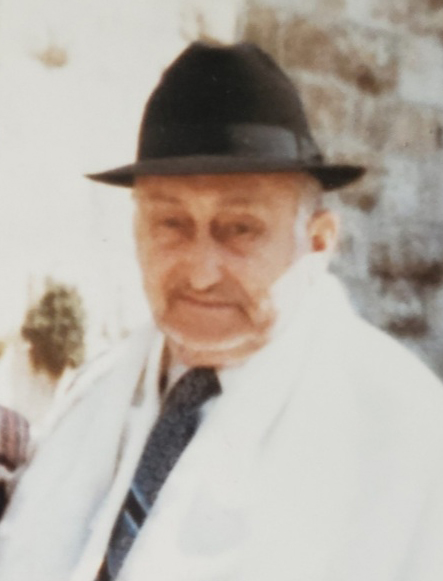
My father of blessed memory, HoRav Pinchos Singer z”l was such a Jew. He loved and cared about people and always showed it. Giving someone the benefit of the doubt or finding merit in their actions, was second nature.
During the second World War, he ran around collecting large sums of money for Vaad Hatzolah, to save Jews trapped in Nazi territory.
After the war years, he traveled all across the USA and Canada, delivering inspirational speeches. He encouraged Jews to respect Torah learning, thereby motivating them to support the financially struggling Yeshiva Chofetz Chaim.

Throughout his life, he would always try to benefit Jews,  wherever he was and whenever possible. It was second nature, part of his essence.

I remember one day walking with him on 13th Avenue, in Boro Park. All of a sudden he started running towards a parking meter that had a red expired sign. He had noticed an officer getting ready to issue a parking ticket. Quickly he put a dime into the meter, before the officer could start writing the ticket. Didn’t understand why he did that, since it wasn’t his car that was being ticketed. So I asked for an explanation. He simply replied, “the car probably belongs to a Yid. Most people living in Boro Park are Jewish. I didn’t want a Yid to get a ticket”.
He was always thinking about how he could help someone else. Its one thing to say I love you. It’s an entirely different thing to show it and do something about it. True love is when we can imagine ourselves being in the other persons predicament and then doing something to alleviate their hardship.
We are taught that if you see your friend’s animal sagging under a load, you are required to lend a hand and help out. Then how much more so, do we need to lend a hand to help out a fellow Jew in trouble.
One of the greatest acheivments one can accomplish in this world, is to help another Jew. When we do that, we are helping one of Hashem’s children. Hashem is deeply in love with the people that help his children out.
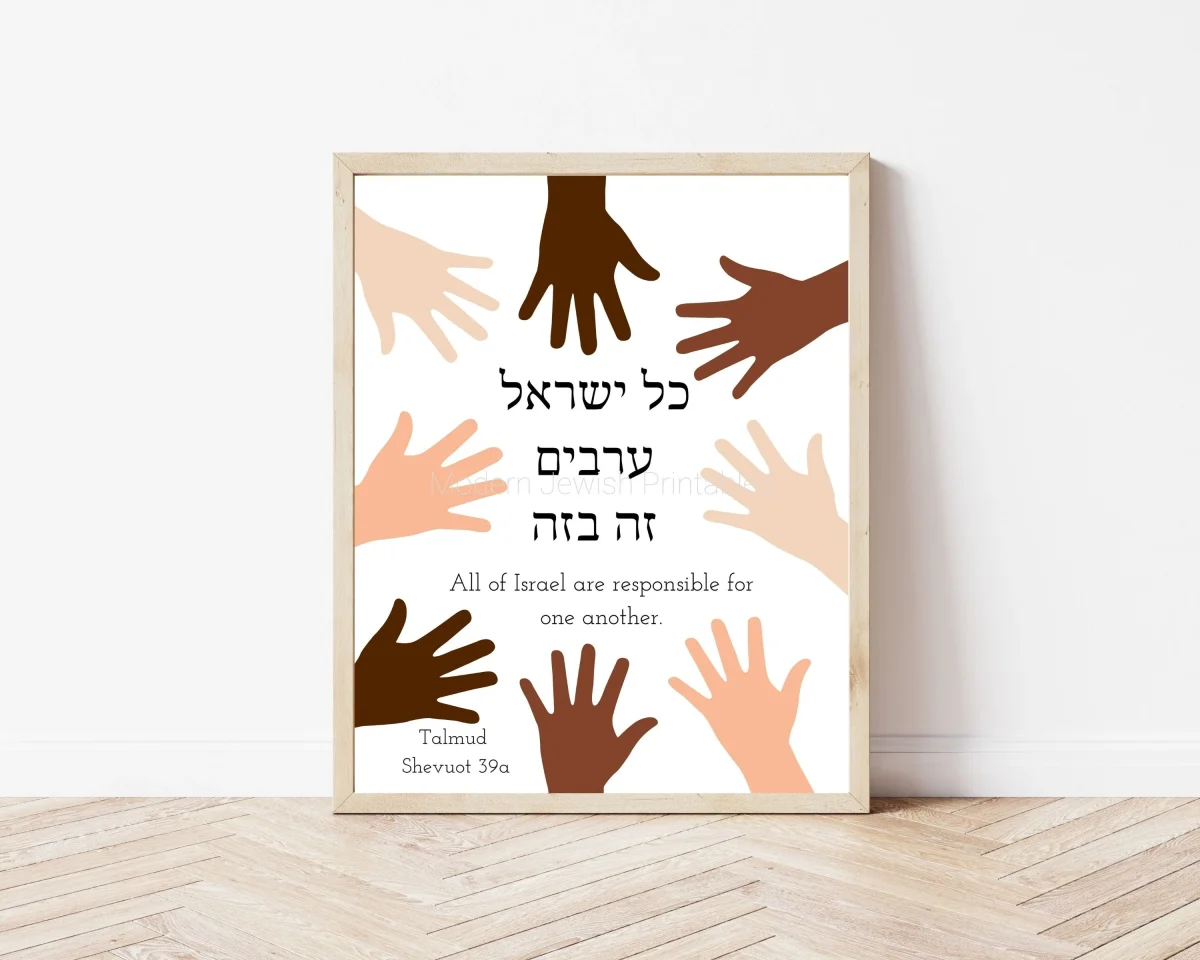
Since we are all children of Hashem, we are bound together as brothers and sisters, responsible for each other. If we don’t look after one another and care for each other, who else will? Only through our deep concern and caring, have we been able to navigate the exile and survive. We only have Hashem and each other. Love your fellow man like yourself, to nurture peace and harmony within your family, your community, and your world. Hashem will surely smile down upon you and shower you with His endless gifts.

Hair Dryer Fire

Once a month we sanctify the new moon by reciting a  blessing and special prayers. We praise Hashem as being One who is משגיח מן החלונות מציץ מן החרכים. He observes through the windows and peers through the cracks. These words took on a whole new meaning, after experiencing Hashem’s protection in a spectacular way. A potential disaster could have destroyed my families home, were it not for Hashem looking out for us. He prepared the salvation before the possible devastation. Without His intervention my wife and I  would have lost everything we thought we owned. How grateful we are to Hashem, for always looking out for our best interest.

One day while in my Brooklyn office, I received an alarming call from my daughter in Lakewood. “Smoke alarms are beeping non stop in the house”. Asked her to please check for a possible cause. Shortly thereafter she called back saying, that she sensed a strange burning smell, but didn’t know from where it was coming. Told her to immediately call the fire department. The firemen arrived and checked the main two floors, but found nothing. Then they went down to the basement. As they opened the door they were overcome by smoke. After searching for a while, they found the cause of the fire and how it had shockingly extinguished itself. Hard to believe what happened. I didn’t either at first. It was Hashem’s way of saying, I am guarding over you and yours, even though you are not around, to do it yourself.

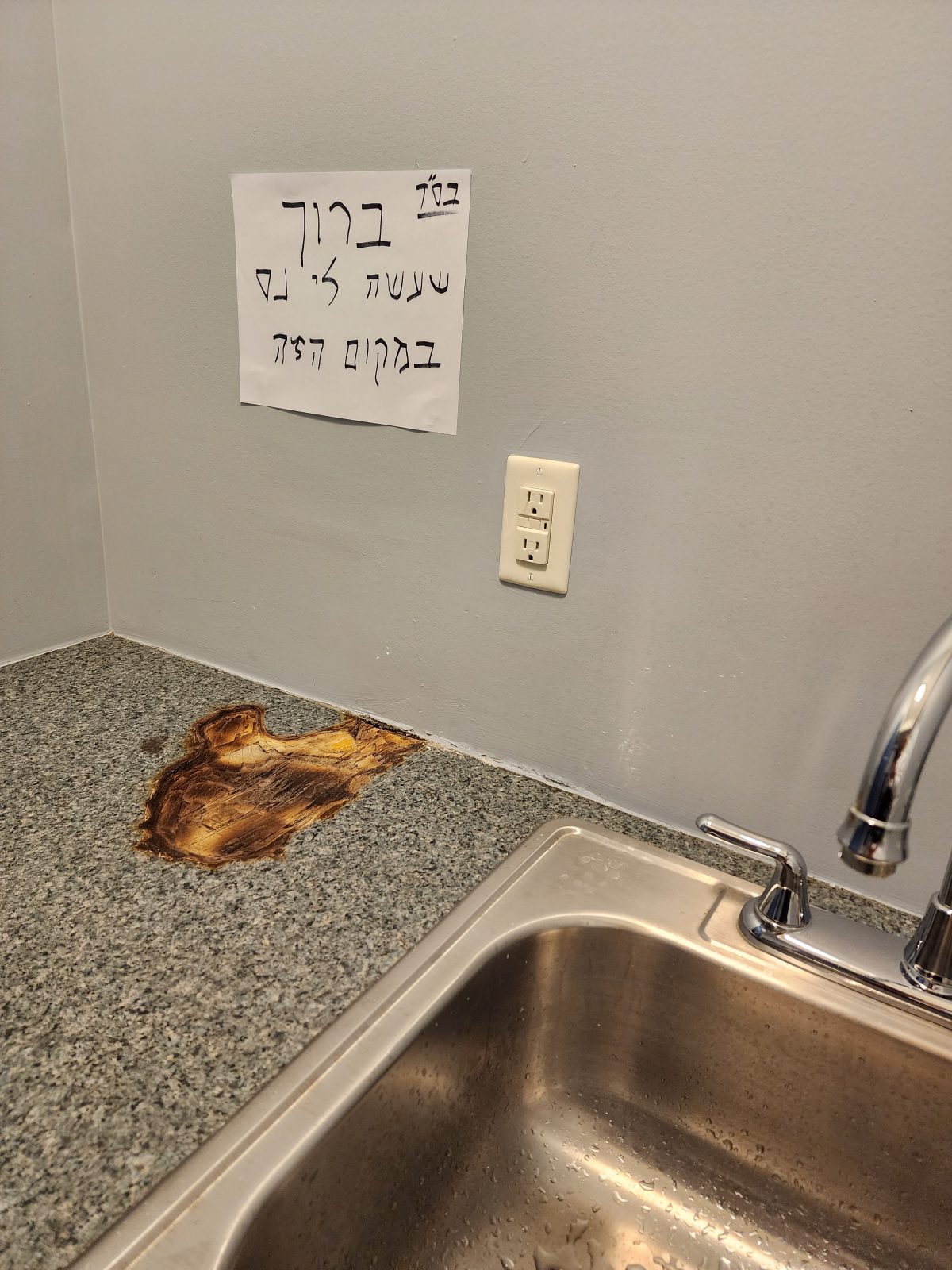
Someone had left a hairdryer  on the sink counter, plugged into the outlet. Although the switch was off, it somehow ignited itself and started a fire. While the hairdryer burnt, it also ignited the laminate counter top, spreading the fire. (Unbeknown to us at the time, electricity can pulsate through a hair dryer, when left plugged into an outlet, even when  switch is off). Resting on the counter at that time, was a plastic bottle containing liquid soap. As the fire increased, it slowly melted the plastic bottle, causing the liquid soap to ooze out and eventually extinguish the fire.

What the firemen found was a burnt counter and the charred remnants of what was once a hair dryer. Their services were not required. The Guardian of Israel, who neither sleeps nor slumbers took care of it. הני לא ינום ולא ישן שומר ישראל
Will never forget the miracle Hashem orchestrated that day and the protection He provided. Easy to imagine what would have happened, if the liquid soap bottle was put away and not left on the counter top. Could have lost everything in no time. Hashem literally sent the רפואה before the מכה. He arranged for the bottle to be left there, in order for it to extinguish the fire. We are taught, אם ה’ לא ישמר עיר, שוא שקד שומר. If Hashem doesn’t guard the city, the watchmen’s vigilance is in vain. My family experienced the true meaning of these words first hand. There was absolutely nothing in our power to avoid what happened. The fire did not start because of carelessness, nor did it extinguish itself because of vigilance. The whole episode, start to finish, was totally out of our control. Thanks to Hashem there was enough liquid in the plastic soap bottle, to ooze out all over the counter and extinguish the fire itself.
Now a large sign is permanently posted over the burnt counter top, that reads .ברוך, שעשה לי נס במקום הזה
Blessed are you Hashem, for performing a miracle for me at this place. It serves as a constant reminder, that we owe it all to Him.
How fragile our lives are. In one moment, everything we worked for and collected all our lives, could have been lost, were it not for Hashem’s endless protection. We therefore view everything we still have, as a new gift from Hashem, everyday. How humble and grateful we need to always be to you Hashem, for the kindness you bestowed upon our family, that frightful day. There are no words to adequately thank you. The recital and conveyance of this miracle, sings your praises.

REAL SEARCHING

We are all familiar with the Mitzvah of Bedekas Chometz. Every Jewish household in the world, on the night preceding the 14th day of Nissan, searches their properties to insure that all Chometz was removed and nothing was overlooked during the cleaning  preparations. It is customary for a member of the household to hide ten pieces of bread in different areas of the house, to insure that the blessing is not recited in vain and that a thorough final search is conducted. Problem is, when night time arrives, most people are exhausted from all the preparations. They might only search procedurally, relying on the cleaning they did days before.

Over the years life has taught me, that it is really important to do a thorough search despite the exhaustion.
Three incidents stand out in my mind, that keep reminding me,  to always go the extra mile, while performing this Mitzvah.
   Was once inspecting my car,  although it had already been cleaned. By chance I happened to find a peice of bread by the hood of the car. Couldn’t believe my eyes. How it got there, is anyone’s guess. Could have been dropped by a bird in flight or hidden by a squirrel. Who knows? What I do know is, that had the extra effort not been made to check the car again, the Chometz would not have found it.
   The sink section outside the bathroom is not a place where Chometz is brought. To crouch down and search under the sink, when it was already swept and mopped made little sense. Certainly there wouldn’t be any Chometz there I thought. But then I remembered what our Holy Sages taught, to search everywhere, even in the cracks and crevices. So with difficulty
I bent down and looked under the sink. How surprised I was to find some macaroni, that somehow found its way there.
   Another time, I was inspecting the dining room which had already been cleaned and set. By mistake I banged into the buffet table and caused one of the framed pictures standing on it, to tip over. Couldn’t believe my eyes, when a small whiskey bottle suddenly appeared out of nowhere. How did it get there? Then I remembered, it was put there as a temporarily prop, to support the framed picture that tipped over now.
How wise our Holy Sages were, to instruct us to do a final search, even after everything was cleaned.
Checking for Chometz can easily become a ritual practice, that we are over and done with quickly. The stories illustrate however, the benefit derived from exerting oneself to perform Hashem’s Mitzvah. In return Hashem gives us a measure of extra assistance.
To take this Mitzvah to a higher level, we might also want to consider inspecting ourselves during this process. Did we leave any Spiritual Chometz  behind like, anger, hatred, greed, lust, jealousy. These character defects are also Chometz, which we are required to  remove from our consciousness. Taking a casual inventory won’t suffice. It requires a thorough checkup, to insure that none of this bacteria resides within us.
Our Sages teach that even a tiny bit of Chometz is forbidden. Therefore it is incumbent upon us to make the extra effort to inspect ALL our possessions, inwardly and outwardly
Many of our Holy Sages felt that removing character defects from our being, should be the chief focus and main purpose of our visit to this planet. Maintaining a clean slate in our relationship with Hashem and also with our fellow man. Can never take for granted, that all is in order, unless we are constantly doing a truthful thorough search. Not easy, but somewhat attainable with consistent and persistent sincerity. Bedekas Chometz all year round, especially in the months of Nissan and Elul.

Mezzuzoh Connection

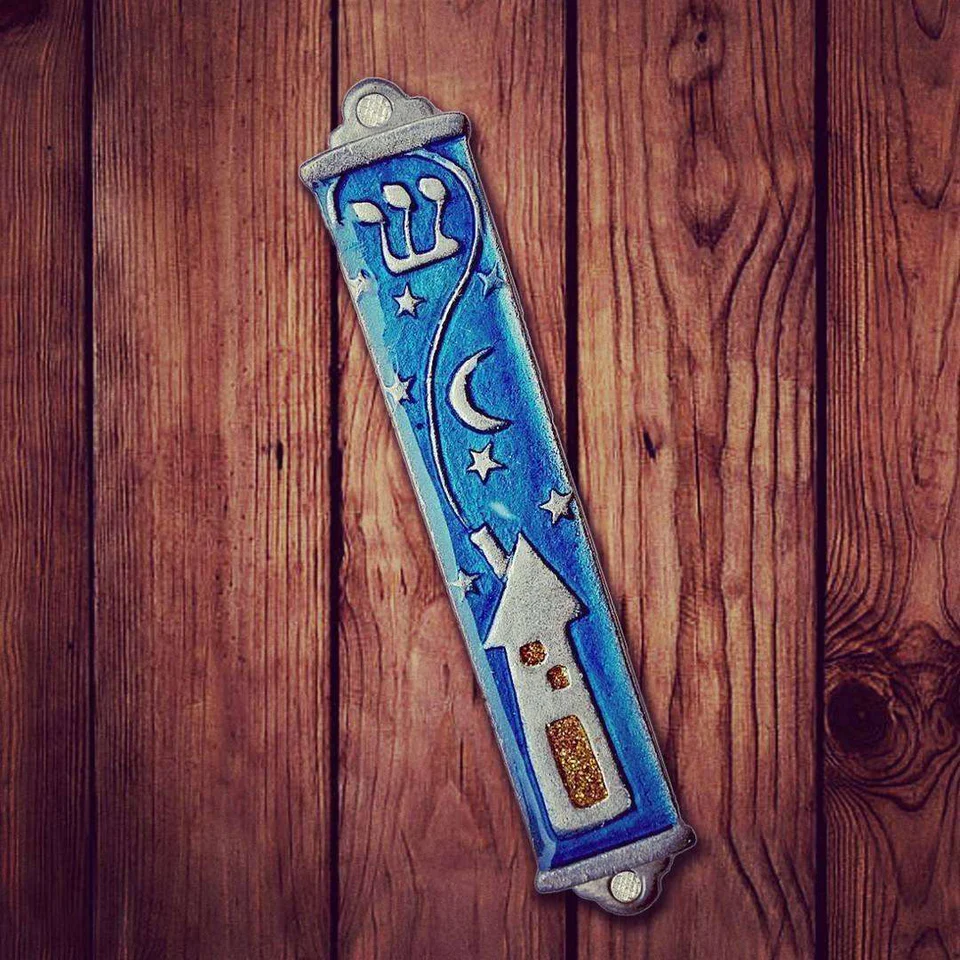
The Mezzuzoh is a permanent fixture, on every Jewish doorpost, of every room, in every home. Besides serving as a protective force, it reminds us, that the room we dwell in, needs to be treated as a Holy place. That Hashem’s Presence is there and that He is watching over us.

Our custom is to kiss the Mezzuzoh. Sometimes we remember and show our love and appreciation for the Mitzvah and sometimes we forget. No matter, the Mezzuzoh is always around, guarding our way, in and out.

On many occasions I had the special opportunity to find myself in the company of my esteemed Rebbe, HoRav HaGoan Chaim Pinchos Scheinberg ZT”L. Whenever he stayed in my home and wherever we traveled, I always marveled, how upon entering a dwelling, he would first stop at the Mezzuzoh, look at it, absorb it’s meaning, kiss it and only then walk in. You could see, how significant the Mitzvah was to him, just by observing his entry. Honoring and observing the Mitzvah meant much more then just mounting it and forgetting about it. It was not just some symbolic decoration adorning a Jewish doorpost. It deserved more then just a casual wave. To him, Mitzvas Mezzuzoh was a constant service, an opportunity to connect to Hashem. Seeing the Mezzuzah, motivated him to express gratitude to Hashem, for arriving safely at his destination. A spiritual connection took place between him and Hashem, at every departure and arrival.
The words we recite in ויתן לך, after Shabbos is over,  “ברוך אתה בבואך וברוך אתה   בצאתך”. blessed are you when you arrive and blessed are you when you leave, meanth something. It was not just words to be taken for granted.
Oh, how I wish, I could kiss the Mezzuzoh the way the Rosh Hayeshiva did.
The Mezzuzoh is mounted slanted. Ever wonder why?
Our Sages had a difference of opinion, as to the proper mounting position. There were those that held, the requirement called for mounting it horizontally, while others were of the opinion, that a Mezzuzoh should be mounted vertically. At the end of the day, they compromised and in the process, taught us a lesson, on how to resolve differences.
Now when we enter our homes and kiss the Mezzuzoh, the slanted position reminds us, how important it is to compromise and exercise flexability at home.
If by chance we forget to, the slanted Mezzuzoh is right there to remind us, on every doorpost and in every room, calling out, compromise, be flexible.
How fortunate are we, the Jewish People, to have been given this Mitzvah. Wherever we go and wherever we turn, it is there, reminding us of our special stature and connection to Hashem. He is always around us, watching us and protecting us. Lucky us.

The Kitchen Delivery

In the early sixties my parents rented a bungalow for the summer in Woodbourne N.Y. The colony consisted of a small group of struggling Holocust survivors. The close knit crowd and pure crisp  mountain air attracted them back yearly. The Pirkei Avos Shuirim my father gave on Shabbos was an added treat. As the families grew, some expansion took place. The bungalow next to my parents, then became available, which my in laws purchased. For my family it was a pleasure, being able to visit both sets of grandparents at the same time. For the rest of their lives, summers were spent in KBW.

Decades later, some of the bungalows were transferred to the children. My in laws bungalow became mine.
It was an old bungalow, which required some refurbishing.
Ordered a simple kitchen, well in advance of the summer season, to insure a timely installation. Due to Covid, delivery was seriously delayed till June. We asked the supplier to inform the trucking company to call twenty four hours prior to delivery. It did not happen.
One day the trucker arrived unexpectedly at our deserted bungalow colony. That’s when he first called to advise, that he was ready to unload the kitchen. Obviously no one was there to accept the delivery. This scenario was exactly what we had tried to avoid. Can imagine our shock. Finally the cabinets arrived and now there was no safe place to store them. Neither the contractor or manager were around. A real dilemma, or so I thought at the time. Surley couldn’t afford to send the trucker away, after waiting so long for the delivery. Having no choice, I took a risk and asked him to place the cartons on the porch. In the meantime I tried to get in touch with the contractor, hoping he would come over right away to inspect the merchandise and put the boxes in the bungalow. Called and called, but there was no answer.
Then for some unbeknown reason, as he was ready to leave, I asked him to check the front door. Maybe I thought, the contractor left the door unlocked by mistake. Hard to believe, but that is exactly what happened. The contractor forgot to lock the bungalow. Problem instantaneously resolved. Merchandise was placed inside the bungalow, secure and protected. Pure divine Providence. Hashem put the cure in place before the dilemma even started. Knowing that the trucker would not make the prior phone call he was required to make, Hashem had the contractor  inadvertently leave the bungalow unlocked. Then placed the idea in my mind to ask the trucker to check the door, for the improbable possibility that it was left open. Hashem literally orchestrated the whole situation to work out in our favor. My plans did not work out, but Hashem’s plans worked out perfectly.
This is what Dovid Hamelech said to Hashem, “there is nothing to fear, for you are
with me”. Orchestrating all the moves of all the players, so that in the end, all the parts of the puzzle fit perfectly. Its really humbling to observe Hashem’s caring intervention in our life.

Holy Sifrei Torah Room

The outbreak of Covid caused havoc all over the world. There was a total lockdown. Life as we knew it, changed overnight. Everyone and everything came to a standstill. The impact of our vulnerability was felt and realized by young and old, with no exceptions. Shuls and Botei Medroshim were closed down and children couldn’t go to Yeshiva. All travel stopped. The world had come to a standstill. Visiting Eretz Yisroel, became impossible. Hashem let the world know who is in charge. Few were spared from the invisible germ. Hashem showed, that status doesn’t matter.

Once the situation stabilized however, Jews began to flock to Eretz Yisroel once again. My wife and I were no exception.
Two years had passed, since the last time we had the opportunity to visit. It had been our custom to travel yearly for my parents Yortzeit and the Agudah Yarchei Kallah. That had stopped with the onset of Covid. Now that the opportunity presented itself once again to travel, we decided to go for Shvuous, with the intention of spending the entire Yom Tov in the old city of Yerusaliyim. There was much to be thankful for. For us, the Kosel was the best place, to express our gratitude to Hashem for sparing us and our family. Towards the end of our second day chutz Yom Tov, I went to the Kosel to study Torah, with the intention of staying there till after Marriv. The Kosel was packed that afternoon, as Jews from all over Eretz Yisroel, who were unable to travel the first day, were coming now to be Olei Regel. Since it was a hot day, I chose to learn in the inner sanctuary. There it would be cooler, less noisy and easier to study peacefully.
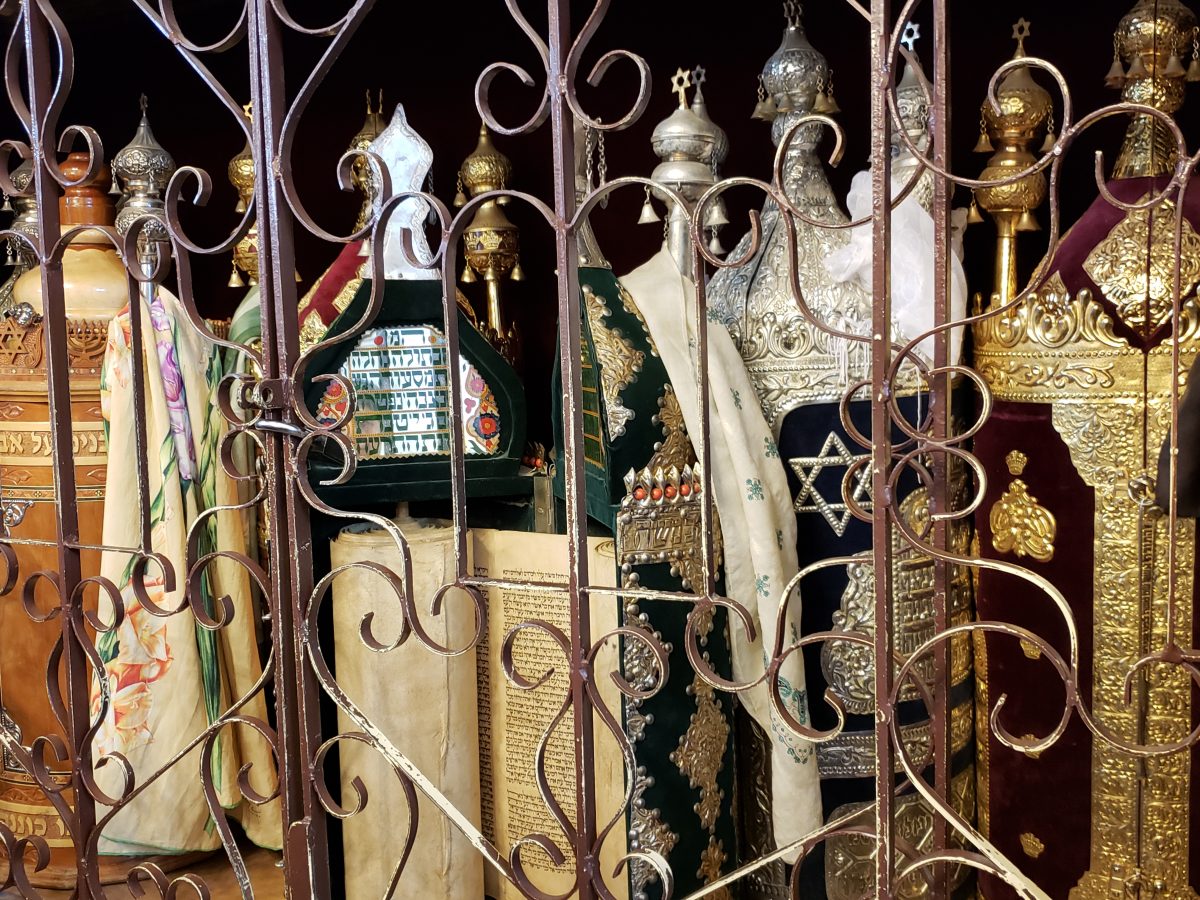
A short distance from the entrance to the left, is a library section where Jews study Torah. Adjacent to it, on the right side, is a special room where all the Sifrei Torah of the Kosel are safely kept. For some unknown reason I ventured into the library section. Upon turning to the right, I found myself facing a room lined with eight open Aronei Hakodesh. From a distance I noticed that they were all filled with Sifrei Torah. Approximately a dozen other Sifrei Torah were resting on a large table in the center of the room. The Sefer Torah Gabbi of the Kosel, just happened to be checking and organizing all the Sifrei Torah that were used throughout Yom Tov. Due to their volume of use, careful records were kept of every Sefer Torah and the Aron in which each Sefer was kept. Was mesmerized by the sight of so many Sifrei Torah in one place. So I approached the Gabbi and explained that I was a visitor from out of the country and would appreciate, if he would allow me to enter the room and browse around. Surprisingly he consented. On seeing all the various old and new Sifrei Torah from all over the world, with all their magnificent adornments, from all different segments of the Jewish nation, a deep spiritual yearning overcome me. What a special privilege Hashem just granted me, to be able to visit this Holy room. So I took the chance to ask the Gabbi, if he would also allow me to kiss the Sifrei Torah in every Aron Hakodesh. Surprisingly he said yes. I started at the right side of the room, working my way around, kissing each Sefer Torah in each Aron. There must have been a hundred or more Sifrei Torah in total. Finally at the end, overcome from the awesome spiritual experience I prayed to Hashem, for my family and the redemption of the Jewish People.
Those unforgettable fifteen minutes were one of the holiest moments in my life, etched in my memory forever. Just imagine for a moment, standing in a room, surrounded by over one hundred Sifrei Torah, brought to the Kosel from all the exiled Jewish communities in the Diaspora. Was thinking, where else in the world is there such a Holy room? The Kosel is the holiest place on earth, that the Jewish People cherish. Our tradition is, that the Shechina is always there and has never left. Such a Holy room in such a Holy place, has to be the Holy of Holy’s in our present exile.
What prompted me to be there at that specific time and to wander off to that chamber, I will never know. What I do know however is that, no spiritual effort goes unnoticed by Hashem. Perhaps because I specifically made the trip from America, with the intention of dedicating the entire Yom Tov to learning and davening at the Kosel, Hashem granted me this unique opportunity.
Next time you are at the Kosel, try to visit that Holy room. You may not be able to kiss every Sefer Torah inside each Aron, but you will hopefully be able to at least kiss each Holy Aron Hakodesh, loaded with the Jewish People’s most prized treasure.

Manna From Heaven

Trying to make ends meet, on a Rebbe’s salary in the late 1970’s, was not easy. Needed to seek some kind of supplementary income in the afternoon, to support my growing family.

One day I decided to visit the famous Hardware Show in Manhattan with another Rebbe, to see if there were any opportunities. Towards the end, we were attracted to the Bulb Miser exhibit. There we were introduced to a very intriguing product, invented by NASA. The technology consisted of a thermistor alloy, designed to protect the Satrun booster rocket from current surges. Scientists figured, they could protect an incandescent light bulb from failing prematurely the same way. By inserting a small round thermistor device between a light bulb and socket, current surges could be prevented from shocking the delicate filament inside the bulb, when turning the light on. The Bulb Miser could extend average bulb life by four times. Considering the cost of bulbs and labor to replace them, especially in commercial establishments, this product seemed to be a winner and easily marketable.

Every year NASA publishes a magazine called Spin Off. It features products, developed from the technology invented in the course of space exploration and how they trickle down to benefit the general public. The Bulb Miser was one such product. It captivated my attention and I saw a potential opportunity here. After some consultation, I risked a small investment and purchased a franchise from the patent holder. With time the investment paid off. In the course of marketing the Bulb Miser, other energy saving devices came to my attention.
I included them in my offer to commercial customers. Shortly thereafter, the compact fluorescent energy saving lamp made its debut. It’s projected savings, prompted commercial property owners to convert their incandescent light bulbs, into fluorescent. One of the great money savers of that time was converting exit signs, which burned round the clock. Reducing energy consumption by 75% in that application offered a quick payback on investment. So I also added an exit retrofit, to my energy savings package.
Soon a public utility found out about the product and shocked me with an unexpected order for 3,000 units. Considering the potential profitability, I figured out how to manufacture the product myself, instead of sourcing it elsewhere and reselling it. Purchased a machine and the raw materials required for fabrication, and packaging. Soon my family and I were manufacturing the product in the basement of our home. It was an opportunity sent from Hashem, not to be passed up. Managed to ship the product timely and Boruch Hashem got paid in full shortly thereafter. It was Yom Tov, to say the least. The profit was equal to two years of my Rebbe salary at that time. Salvation sent straight from Hashem to my family.
Two years passed and then one day I received a shocking phone call from the public utility. They were requesting permission to return 2,700 units and to get a full refund. I told them that it was impossible to authorize such a return, two years after the original ship date, plus the technology had already advanced and changed.
I was puzzled however, how it was possible for the utility to order 3,000 retrofits in the first place and now two years later, want to return 2,700. It just didn’t make any sense.
Asked the question and the answer I received was quite shocking. The utility staff was doing inventory and found 2,700 extra exit retrofits on their shelf. They couldn’t understand why. After some investigation they discovered, that the original purchase order was only supposed to be for 300 units. The secretary that typed the purchase order, by mistake added a 0 to the 300 which became 3,000. Now they found an extra 2,700 retrofits, which they didn’t need and were never supposed to be ordered in the first place. Their answer startled me.
I began to wonder what actually took place here.  Hashem literally sent an Angel, to slightly flick the pinky of the secretary, as she was typing the purchase order, resulting in an additional zero. To top it off she didn’t notice it, nor did her supervisor. Had she checked her work prior to releasing the order, she would have caught it. Hashem has many messengers to provide Jews with Parnosah.
When we say that a person’s livelihood is decided by Hashem every Rosh Hashona, it’s 100% true, to the last dollar.
I did nothing for this. Hashem made it happen, start to finish. From the profit of that large order, received by mistake, I was able to develop the business further.
Looking back now, 40 years later, I have found, that no other company besides mine, that originally bought a franchise exists today, including the patent holder franchiser. It amazes me, when I think about the original marketing slogan the franchisers used to promote the product. “We went to the moon to bring you Bulb Miser”.
Truthfully speaking, one of the reasons they went to the moon was, so that a poor Rabbi should be able to provide for his family. Hashem provided, despite lacking a college education or business experience. Only through pure Seyate Dishmaye.
Went to Rav Yaakov Kaminetsky zt”l to consult. He told me, “not always does Hashem send people many great opportunities in their lifetime. Sometimes he may only send one great opportunity. If you don’t take advantage of it and miss it, you may never have such an opportunity again”. He encouraged me to try and take the business to the next level and blessed me to continue educating and spreading Torah  the rest of my life. Was able to support my family from this single opportunity for forty years. When Hashem sees honest effort and trust in Him, He takes over and makes it all happen. No words are adequate to Thank You Hashem.

WITH OUR WHOLE נשמה

If Hashem didn’t lead me to that specific place at that specific time, I would have missed out on everlasting inspiration.
Had the opportunity one morning to daven Shacris at the great Bobov Chasidic Center in Boro Park. It is a popular place, where people gather three times a day to daven. They have Minyonim for Shacris, Minche and Maariv round the clock. You can always be on time for davening in Bobov. Whenever you arrive there is a new Minyan ready to start.
One morning, after finishing my morning prayers, I happened to  pass by the main synagogue, when I noticed a special Tish taking place. The Bobover Rebbe was speaking to a large crowd of his Chassidim. Just then he happened to be speaking about the prayer  כל הנשמה תהלל י-ה הללוי-ה, which we recite every morning. His talk caught my attention when he said, “dont think that the words only mean, every Neshoma should praise Hashem. There is a deeper message to keep in mind when reciting those words.                כל הנשמה, with our entire נשמה, with our whole being, we are required to praise Hashem. We must give it our ALL throughout davening”. What is interesting he bemoaned, “that even while we are saying the words כל הנשמה, our entire Neshoma is not consciously there with us. At least when we announciate these words, our entire concentration should be there”. What the Rebbe was trying to point out was, how much effort one is required to put in, to be conscious of Hashem Presence while davening. That we need to be focused and praise Hashem with ALL our ability. We must make sure our minds are not elsewhere. Our prayers must be wholesome and complete, with our fullest concentration, with complete heart, mind and soul present.
Never have I forgotten those words, I happened to luckily hear on my way out. Daily they ring in my ears, especially when saying כל הנשמה. Prayer is not just about mumbling words and getting done. Most important is to be fully cognizant before whom we stand in prayer and to put our entire heart and soul into understanding the words we are conveying. To cherish the opportunity we have been given, to speak to Hashem directly without any median.  Connecting ourselves to our Creator, our life giver and supporter. Our words need to affect us and awaken within us a closer relationship, through our understanding of the significance of the words we utter. We must know what we are talking about when speaking to the king. Speaking to the king and not knowing what we are talking about  while speaking to him, is a lost opportunity. Could have had meaningful communication with our creator.
To receive Hashem’s full blessings, we must ask properly. With ALL our heart and soul, with ALL our feeling. With an understanding that our lives totally depend on Hashem’s graciousness.
All blessing Emanates from Him alone

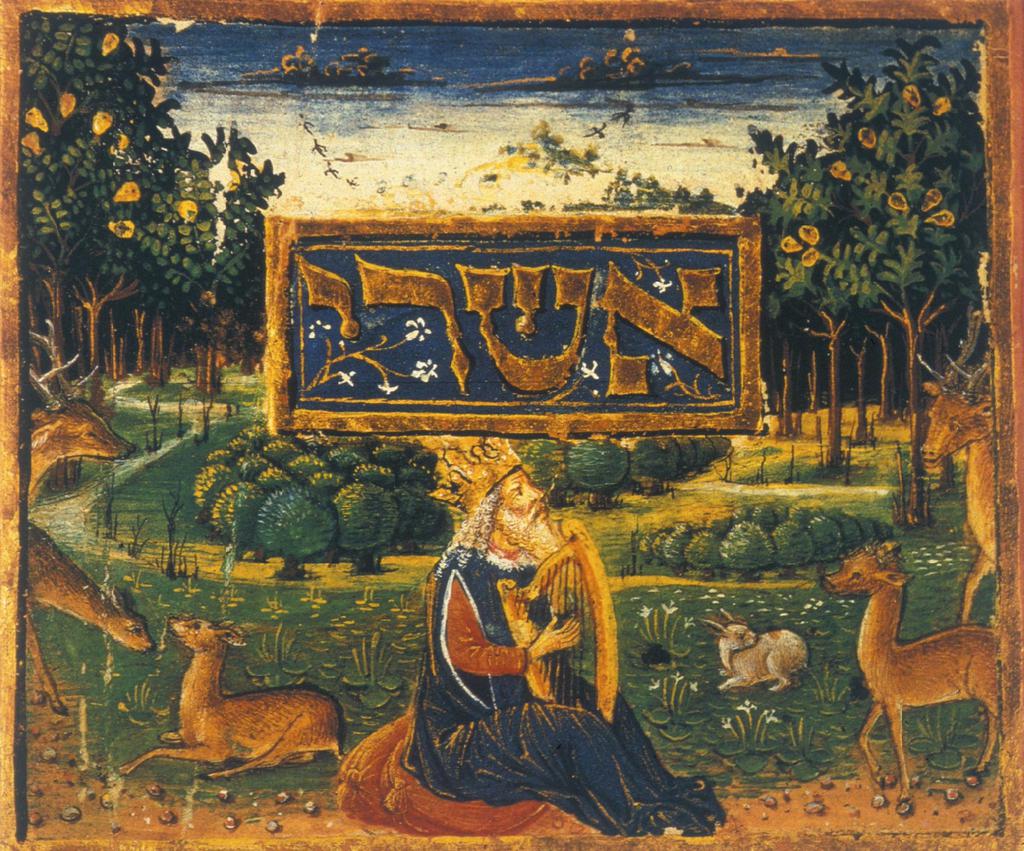
ASHREI – אשרי

In 1971 I studied in Yeshivas Torah Ore located in Kiryat Mattersdorf Yerushaliyim. On Shabbos the young boys of this  developing community, wasted away their time. Flash backs, of the inspirational Shabbos Pirchei groups I enjoyed as a young boy, growing up in Boro Park, encouraged me to create the same here. After some quick arrangements, Bnei Simcha was founded.

This new youth group, would hopefully keep the young boys of this community entertained and inspired Shabbos afternoons. Boys of all ages under Bar Mitzvah would get together, in the community Shul classrooms. I would tell them stories, teach them new songs, talk about the Parshe, launch contests, hand out prizes and nash bags.
These were not easy times for the parents and children living in Yerushaliyim. People were still recuperating from the Six Day War with new threats on the rise. The amenities that abound today in Eretz Yisroel did not exist then.
The Shabbos programs brought meaning and simcha into the children’s lives, while bringing their parents some relief. Bnei Simcha grew rapidly with three different groups running simultaneously.

A membership card was issued to each child, giving them a sense of belonging, which also helped support the effort. Parents were happy to pay a small membership fee which enabled the funding of prizes and nash for all groups. Yeshiva friends of mine soon joined the effort, donating some of their Shabbos off time, to help keep the children fullfilled. Eventually our success enabled Bnei Simcha to secure some funding from the Jerusalem Municipality, which further helped support our efforts.

There was this one challenged special needs boy Moshele, whom I will never forget.
It happened during one of the groups, when I was explaining the Tefilloh of Ashrei to the boys. All of a sudden Moshele screamed out, that he had his own explanation he wanted to share. You can just imagine the surprise his outburst caused, since he was somewhat compromised and never participated much.
The room fell silent and Moshele went on to explain his own understanding of the words אשרי יושבי ביתך עוד יהללוך סלה
ASHREI:
“Min darf gebben ah shrei”.
We need to give a scream.
YOSHVEI VEYSEHCOH:
“Farvos zits de in hoiz?
Why do you sit at home?
OID YEHALELUCHO SELO
“Mer darfen noch loibin
Der Aibershter”
We need to praise Hashem even more.
Now more than 50 years have passed. What he said that Shabbos still remains engraved in my memory. Will never forget the powerful message, sent down from above, through this special boy.
A scream must go out to the Jewish world, not to waste  precious time, sitting home, occupied with mundane things. Important to spend more time in the Beis Medrash, praising Hashem.
We never know what is going on in the minds of the special children in our midst. They undoubtedly are special holy נשמות. Their perspective on life may even be clearer then ours at times. When they speak up, they may be providing us with a special spiritual message that only they can share.

I MISSED OUT

Sometimes there are good things we do in life that seem to go unnoticed. Unfortunately we don’t receive any recognition for them. At times we may help someone out, with no thank you in return. As a student we may have put in our best effort, and it goes unnoticed  by the teacher. Students at times reveal why they are discouraged. “What’s the use, my effort isn’t appreciated or noticed”.

Recognition and appreciation
are key elements in advancing healthy mental and emotional growth in human beings. It is the tendency of people to reciprocate with appreciation when they are shown appreciation. It is true, we don’t only live our lives properly,  in order to receive honor or to be appreciated. However, there is no denying that the encouraging feeling one has from being appreciated, goes a long way. It is fuel that keeps people going and energizes them to continue on the right path and to do good deeds. When we train ourselves to express our appreciation for another persons efforts, by saying thank you, or acknowledging their contribution to society, it also trains us to be more grateful to Hashem and to also say thank you to Him.
There is a saying that no good deed goes unnoticed. If people don’t pay attention, Hashem surely does. Sometimes He lets you know directly and sometimes He lets you know indirectly. Whatever the case may be, saying a kind word or giving a compliment, encourages people and allows them to know, that they make a difference.
Spent a Shabbos in Tom’s River. After davening a middle aged man approached me out of the blue and asked, “Are you Rabbi Singer? Did you teach in Yeshiva Karlin Stolin, Brooklyn some 30 years ago? I missed out. You could have been my Rebbi. I remember you were the best Rebbi.”
Hard to imagine receiving such a compliment from an individual that was not even in my class. Yet he came over, just to express positive encouraging feelings. How special. It was nice to hear some thirty years later, that my presence in the Yeshiva made a difference. Not so sure if his compliment was totally true and what interaction we had back then, that prompted him to say what he said.
Everyone can agree however, that receiving a compliment is refreshing. Therefore it would  be wise for us to train ourselves to be complimentary whenever possible, so that others can feel the same way we felt, when we received one.
One of the greatest Mitzvos an individual can perform is to make another Jew, one of Hashem’s children, feel good. It doesn’t even, have to cost any money, nor does it require any strenuous action. Just one good word, to at least one person every single day, will surely go a long way.

Wagshal Appliance

As a youngster growing up in Borough Park in the sixties, I came to know R’ Wagschal, a truly devoted Chasidic Jew, steadfast in his adherence to Torah and Mitzvos. He would not compromise on anything, when it came to leading a religious life, no matter what the situation.

He had a small appliance store through which he supported his family. All types of people would come in to purchase, washers, dryers, refrigerators, air-conditioners, televisions, radios, tape recorders etc. If you asked him however to sell you a television, he would politely refuse and say, “what I consider improper to look at, I won’t sell to you”. Although televisions in those days were a hot sale item, it didn’t matter to him. He regularly forfeited potential daily profits, firmly believing that by doing Hashem’s will, his livelihood would not be diminished in any way. “What is meant for me to have, was already inscribed on Rosh Hashana. Not selling televisions will not affect me negatively”.

My mother of blessed memory, a Holocaust survivor, would always say, “it is one thing to say, I have trust in Hashem and it is an entirely different thing to actually live with trust in Hashem”. Living with trust  means fully relying on Hashem and having full confidence, that whatever is destined for me, I will receive. Knowing with certainty, that you will not be affected negatively by serving Hashem properly.
This Yid was practicing real live conscious Judaism and was ready to sacrifice for it. He would have no part in spreading bad influences. Looking for loopholes was out of the question. Just tried to do the right thing. He would not lend assistance to any matter that could possibly cause another Yid to become disconnected from Hashem.
On the contrary, he would visit Shuls and raise money to help Jews out whenever he could.
In short he was intoxicated with his Judaism. A real role model that didn’t just talk the talk, but walked the walk.

Rav Michels Levaye

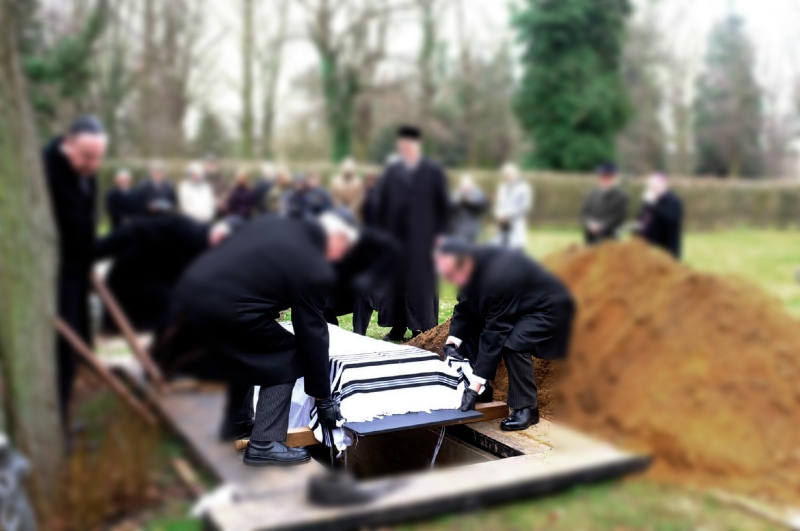
Had an unforgettable, special Rebbi in Yeshiva Ketane Ohel Yaakov, who left an everlasting impression upon me. He was a survivor who had been through the trauma of the Holocaust, yet remained upbeat. Besides teaching us Torah ,he would  sing with us heart warming songs and tell us stories that captivated our being. His  smile, care, respect and understanding for every talmid was extraordinary. He earned a special place in my heart and probably in the hearts of all those who knew him. Whenever we met, we would greet each other warmly and happily. This went on throughout my teenage years and even after I got married. When there was a simcha in my family, I would try to invite him. When I became a Rebbi myself in later years, it was his performance as a Rebbi, I tried to emulate in the classroom. After moving away from Brooklyn, we lost some contact. Occasionally I would drive in to attend to matters. On one such trip, while driving down 17th Avenue, I ran into a traffic jam. As my car slowly moved along, I noticed throngs of people gathered together on all sides of the street. Something was obviously going on. I rolled down my window to ask someone what was happening The answer shocked me. The funeral of my beloved pastime Rebbi, Rav Michel Hakohen Schwartz, was taking place. I could barely catch my breath. Hashem just sent me here today, to this specific place, at this specific time, to be able to give my Rebbi his last deserved honor. The very man who impacted my life so much as a young boy. I immediately parked my car and hurried over to participate and carry the Oron down the street.
I was thinking to myself, had I arrived an hour later or an hour earlier I would have missed the Levaye completely.
I often wonder why I had the merit to be there just then. The conclusion I came to was, that when someone tries to stay close to his Rebbi, Hashem says, you want to be close, I will arrange the events to make that possible, till the very end. I was given the chance to say goodbye and farewell to a person who meant so much to me. My Rebbi earned his students respect with his forever adoring smile.
Hashem keeps a watchful eye on how we conduct ourselves throughout our lifetime. At the appropriate time He repays us in kind. He repayed me by arranging for me to be there on that day and repayed my Rebbi by having me there.

ITS BASHERT

Quaker Hill is one of the most renowned bungalow colonies in the Catskills, located in Monroe New York. Fortunate to have been one of the original sixty members, when it was founded in the early 1980s. Most of the families that spend their summers there, are offspring of Holocaust survivors. Over the years the colony developed into a unique, thriving, tight knit, family oriented, Torah  community. Everyone raising their children together, sharing in simchos and growing together spiritually. A beautiful Beis Medrash, stocked with many Seforim, weekend shuirim and lots of camaraderie. Many important initiatives serving Klal Yisroel, were originally launched from here. The colony has come to be known as a very hospitable, charitable place, dispensing Tzedakah to Klal Yisroel.

One can’t imagine the heartbreak and trauma that enveloped this colony one morning, when we awoke to tragic news. One of the mothers, lost control of her car, while driving back at night, leaving behind many orphans.
As Gabbi of the Kehilla at that time, I witnessed the heart wrenching cries, bewilderment and shock that gripped the entire colony. It was obvious, that something needed to be done quickly to ease the emotional pain and stop the confusion we were experiencing.
So I reached out to the Novominsker Rebbe, who was residing in Liberty, N.Y at the time. Hopefully he would be able to provide some guidance, comfort and healing. After explaining what happened, the Rebbe accepted the invitation to come and speak to the colony. An assembly was arranged for the following Sunday, at which the Rebbe and Rov spoke, bringing some consolation and understanding. After the speech I drove the Rebbe home to New York.
During the private time we spent together that day, traveling to and from the colony, I brought up the subject of Bashert and what it really means. I said to the Rebbe, “no matter what happens, the first thing said is, “its Bashert”. Rebbe, does it make sense, to blame Hashem for everything that goes wrong and say its Bashert, especially when it happened due to a persons own negligence? Hashem is an אב הרחמים, a merciful father.
If someone is reckless, takes unnecessary risks, lives on the edge, behaves abnormally, contrary to Hashem’s world and then gets hurt, is that also Bashert?
After discussing the subject back and forth, the Rebbe said. “The word Bashert is the most misused word in the Jewish dictionary”.
The Rebbe’s answer was shocking and left a deep impression on me and on all the people I have shared his answer with over the years.
How important it is for us to understand the words we say and not just apply them to all situations haphazardly.
The word Bashert is
appropriate only when one lives life properly, according to the precepts Hashem set up for the world to run by. If people do things that contradict the natural world order and get hurt in the process, that is not  Bashert. It’s plain foolishness on their part, and they are liable for the resulting consequences that follow. Expecting miracles at a time that contradicts Hashem’s natural order, is not the way a Torah observant Jew ought to think.
So it is important for us to live safely and properly and conduct our affairs according to the natural order in which Hashem set up His world. In other words, it is improper for one to blame Hashem for any mishap that takes place due to foolishness or negligence. It is true that ” ‘שומר פתאים ה “, Hashem guards fools. That does not mean however, that one should be a fool, or live like a fool and then depend on Hashem’s mercy. It may or may not come, depending on one’s merits.
We need to live properly and train our children to follow
our example.
With Hashem’s guidance and graciousness we will merit Hatzlocho, Brocho and stay protected throughout our lives.

Meseras Nefesh for Minyan

Many years ago I traveled to Poland, with Project Mesorah. It was a spirited mission led by Rabbi Paysach Krohn. Needless to say it was a most inspiring trip.
To go back in time and actually see how Jews once lived, prior to the attempted extermination of World War II, was an eye opener and very infomative. Experiencing the old country, which I had heard so much about throughout my youth and having the opportunity to relate to the stories my parents told me, was special. Standing on the very soil of the Auschwitz concentration camp, where my mother was once incarcerated and suffered so much, was unbelievable and very healing.  Here I was, a child of a Holocust survivor, reciting Kaddish at the site where the gas chambers once stood and where much of my family was slaughtered. In a certain sense, survival is victory and here stood the descendent, of a courageous woman  who miraculously escaped the gas chambers.

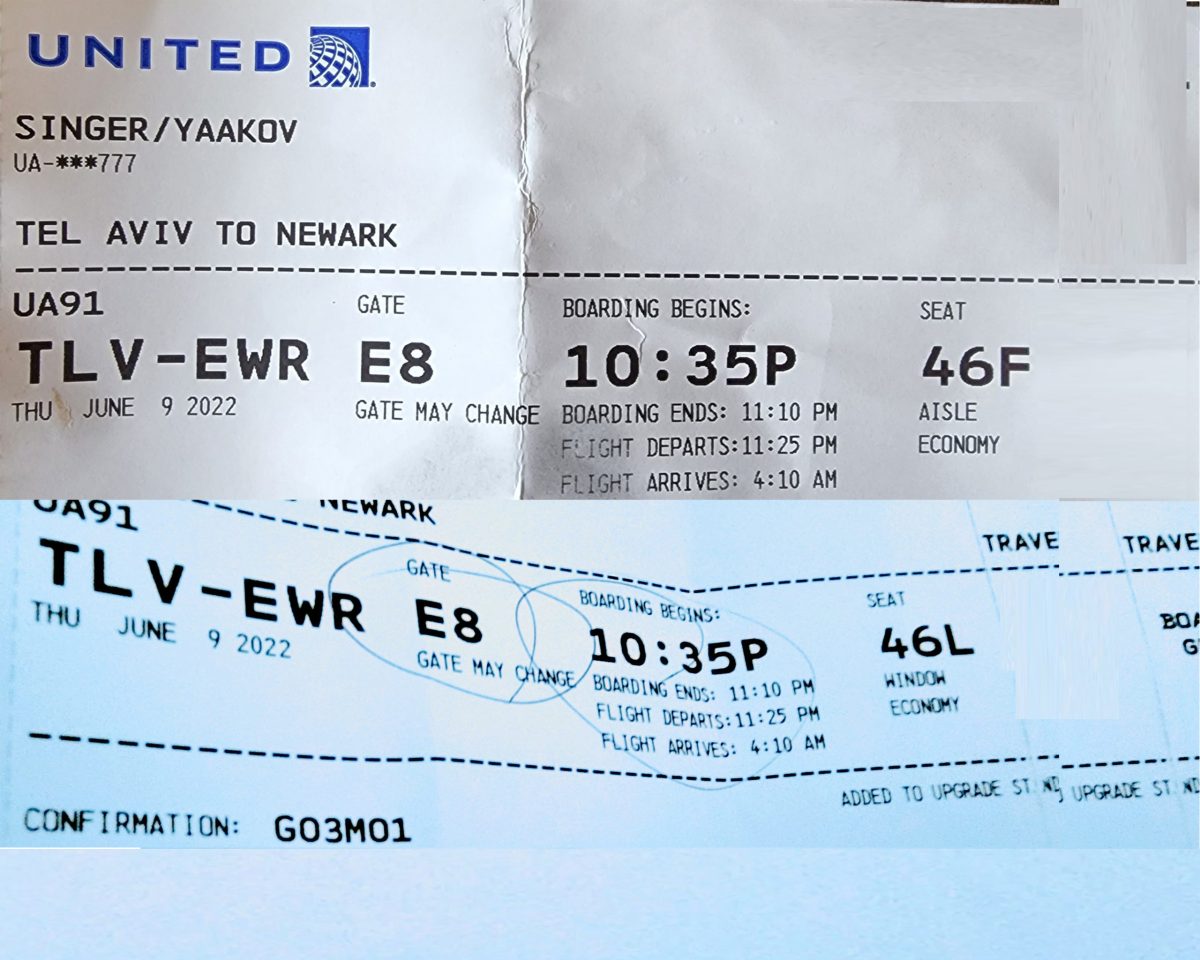
The mission started in the airport, where all participants met, arriving on different flights. My flight was delayed in France. By the time we arrived in Poland the mission had already left to daven Mincha in one of the surviving shuls in Warsaw. I caught up with the mission at the Einsatz Platz. This was the place where all Jews were rounded up before deportation. Hard to imagine the pain and suffering that took place here. Families were torn asunder. Husbands were separated from their wives and children from their parents.  Not having davened Mincha yet, I asked Rabbi Krohn if I could daven and say a loud Kedusha.
It was certainly a very meaningful moment when the entire mission recited Kedusha all together at this place. The very place from where  children and mothers were shipped off to their deaths. Now some 60 years later, in the very same place, their descendants were reciting Kedusha.
Why did this happen and how did this happen. How it happened was only because we missed our connecting flight in France. At the time we were upset at missing our connecting flight, but after looking back we realize that it only happened because Hashem wanted Kedusha to be recited in this place. He made us miss the connecting flight in order to make that happen.
As Jews it is important to understand who is really orchestrating our lives. Truth be said it is only Hashem. Unfortunately  we think we are orchestrating our life, when in reality it is all Hashem. We are only going through the motions. We think it’s us but it is really him. We are where we are, at a specific place and at a specific time, for a specific purpose. Many times we only find out about it later. Sometimes Hashem reveals his plan to us later on,
for us to find out that what we thought makes no sense, really makes lots of sense. He does that to let us know that He is always with us and that as a Jew we are never alone. He does things with us which seemingly are sometimes out of the ordinary and later reveals his master plan in order to draw our attention to Him. By being connected to Hashem we are able to connect the dots in our lives.

Hold the Chumash

In 1961, as a young ten year
old boy, I would daven Shacris every morning in the shul of the Shtrosnitzer Rebbe. He was a Holy Yid, descendent of the Nudverna Dynasty, who miraculously survived the atrocities of the Holocaust.

In those days there were very few Jews living in Borough Park, especially on 17th Avenue and 51st Street, where I lived. The community for the most part consisted of Italian Americans with some modern American Jews and newcomers like my parents, survivors of the Holocaust. Was not easy for the Shul to gather a Minyin ⁶⁶ýevery morning, especially in this non Chasidic community.

I remember how the Holocaust survivors would talk about the trials and tribulations they suffered in the Nazi concentration camps as youngsters. What happened to them in the war years and how they were torn away from their murdered families. They would bemoan the difficulty of being  alone in a new country, without anything or anyone to rely on. The conversation was always about how they survived and escaped and the concern of how they would pull through in the future. They were all hard working men trying to make a living for their new growing families, despite the lack of education and language barrier. They would try to daven with a Minyin every morning before going to work. At times it was a challenge to put the weekday Minyin together. When there were only nine and the time for Borchu arrived, the Rebbe  would come over to me with a Chumush and hand it to me saying “Yankele, halt der Chimish shtark in de hent leiben der”. Hold the Chimish tight in your hands, next to you. Me with holding the Chimish tight created number ten. Even though I was under Bar Mitzvah they proceeded with the regular prayers.
How different it is today. We are fortunate to be able to daven with a Minyin almost any place and any time. What we take for granted today, was a struggle once upon a time. Let’s appreciate the times we live in and our ability to serve Hashem without hindrance or need for sacrifice. Timely Minyonim we have. The question is if we are timely. It would certainly be proper for us to be on time, even though we are not depended on.

TZITIS – WHAT A HOT DEAL

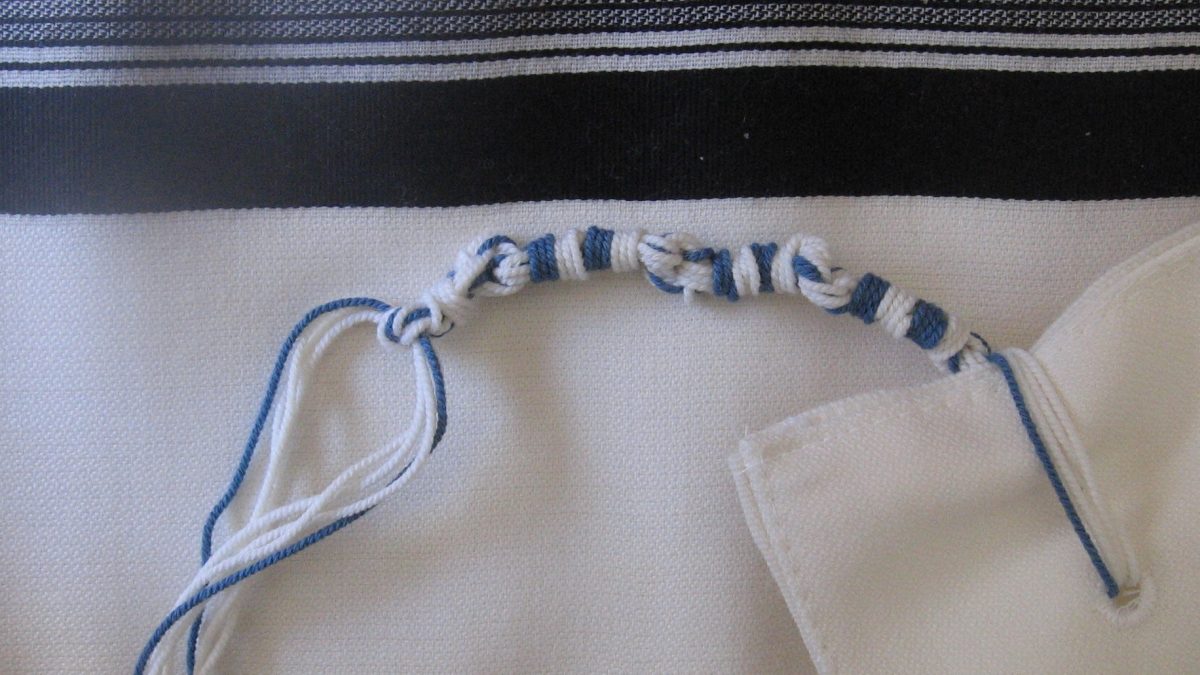
One of the simplest commandments to perform is the Mitzvah of Tzitis. Buy it, maintain it, wear it. You put it on in the morning and then you are on automatic pilot throughout the rest of the day  without having to do anything else. Imagine being able to earn while not working. That’s Tzitis, earning Mitzvos every second with very little effort. An insurance protection policy, offering unprecedented benefits to the individual wearing them. It’s a deal no
one can afford to pass up.

My Rosh Hayeshiva, HoRav HaGoan Chaim Pinchos Scheinberg Zt”l was known far and wide for his uncompromising performance of this Mitzvah. He wore many pairs and when asked why, he would joke and say, “I wear for for all those that don’t”.
How foolish on our part would it be to forfeit such a priceless opportunity.

As a student in the Yeshiva, I had the privilege of sitting right next to him. One day he gave a Halocha Shuir about the importance of wearing Tzitis. He also encouraged everyone at that time to try and wear a woolen garment, even in the hot summer months. When I asked what was wrong with wearing cotton, since its cooler, he simply responded that wool was the higher standard. Then he laughed pointing to the pile of woolen Tzitis he was wearing and remarked,
“better to be hot in this world and cold in the other world, then cold in this world and hot in the other world”.
He trained us by example, to try and perform all Mitzvos in the best way possible. He would say “when it comes to your personal endeavors do you settle for second best, then don’t settle for second best when it comes to performing Hashem’s Mitzvos. Live by a higher standard.

Einsatz Platz

Many years ago I traveled to Poland, with Project Mesorah. It was a spirited mission led by Rabbi Paysach Krohn. Needless to say it was a most inspiring trip.
To go back in time and actually see how Jews once lived, prior to the attempted extermination that took place during World War II, was a real eye opener and very informative. Experiencing the old country, which I had heard so much about throughout my youth and having the opportunity to relate to the stories my parents told me, was special. Standing on the very soil of the Auschwitz concentration camp, where my mother was once incarcerated and suffered so much, was unbelievable and very healing.  Here I was, a child of a Holocust survivor, reciting Kaddish at the site where the gas chambers once stood and where much of my family was slaughtered. In a certain sense, survival is victory and here stood the descendant of a courageous woman, my mother, who miraculously escaped the gas chambers.

The mission started in the airport, where all participants met, arriving on different flights. My flight was delayed in France. By the time my wife and I arrived in Poland, the mission had already left the airport, to daven Mincha in one of the surviving shuls in Warsaw, Poland. I caught up with the mission as they were leaving the shul on their way to the Einsatz Platz. This was the place where all Jews were rounded up before deportation. Hard to imagine the pain and suffering that took place there. Families were torn asunder. Husbands were separated from their wives and children from their parents. A large memorial now stood in this place with the names of the departed engraved on its stone walls.
Not having davened Mincha yet, I asked Rabbi Krohn if I could recite a loud Kedusha.
It was a very meaningful moment, when the entire mission recited Kedusha together with me from the depths of our hearts, at this special place. The very place from where children and mothers were shipped off to the Nazi concentration death camps.
Now some 60 years later, in this very same place, their descendants recited Kedusha.
The holy flame of the Jewish people will survive forever.
Why did this happen and how did this happen? It happened only because we missed our connecting flight in France. At the time we were upset at having missed our connecting flight, but after looking back, we came to realize that it only happened because Hashem wanted Kedusha to be recited in this place. He made my wife and I miss our connecting flight in order to make the special moment happen.
As Jews, it is important to understand, who is really orchestrating our lives. Truth be said, it is only Hashem. Its unfortunate, that sometimes we think its us. We are only going through the motions. We are where we are, at a specific time and place, only because Hashem has a specific purpose in mind. At the time we don’t know the reason. Sometimes Hashem reveals his plan to us later on in life. Then we find out, that what we thought made no sense, really made lots of sense. Hashem does that, to let us know that He is always with us and that as a Jew we are never alone. He does things with us, which sometimes seem out of the ordinary. Later on He reveals His master plan, in order to draw our attention to Him. By being connected to Hashem we are able to connect the dots in our lives.

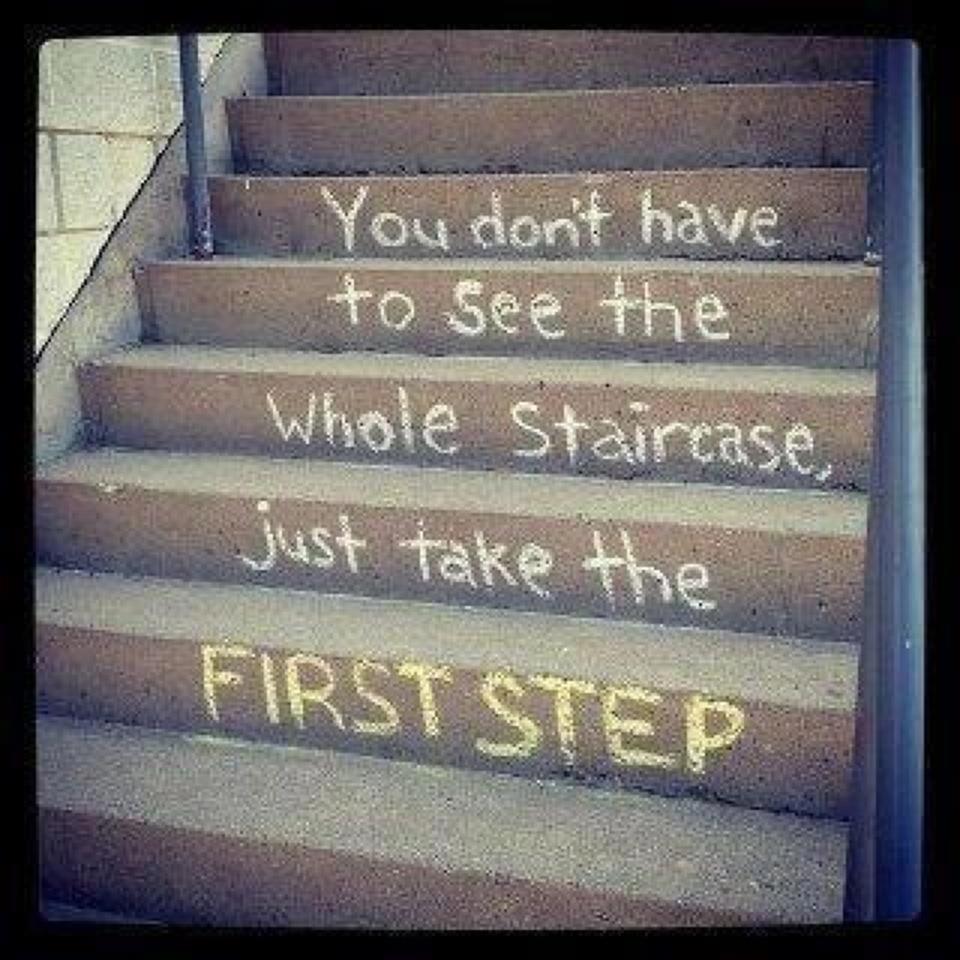
TAKING THE FIRST STEP

One day while visiting my elderly sofer Rav Kalmen Pinter, he suggested that I purchase Rabbainu Tam Teffilin. I respectfully told him that it was not my Minhog. He would not take no for an answer. Everytime I met him he would say, “Nu R’ Yaakov when will you purchase the Teffilin”. He would go on to explain the importance of wearing them, adding that it was high time for me to consider at my age doing something extra for a zechus.
The day finally came when I said to him, “I will purchase the Teffilin the day after my wife and I merit to walk our youngest child down to the Chupah. That would be the perfect time, upon entering a new chapter in life”.
He wasn’t satisfied with my answer. “Don’t procrastinate, you need to buy them now. If you take the first step now, Hashem will bless you to start wearing them shortly”.
Even though my daughter wasn’t a Kallah yet at the time, the Teffilin were ordered, with the hope and anticipation to soon merit the great day, when I would begin wearing them. I said to Hashem, “if it be your will for me to wear these new  Teffilin I have purchased, I am prepared to do so everyday for the rest of my life, starting the day following my daughters Chasunah”.
I paid for the Teffilin and put them away for safe keeping.
It didn’t take long and my daughter became a  kallah. Her wedding followed shortly thereafter.
True to my word, the next morning I took out the new Rabbainu Tam Teffilin and wore them for the first time, with a great expression of  Hakoras Hatov to Hashem.
Taking the first step, trying to advance in our Avodas Hashem, is a way to merit the additional zechusim we need to help carry us through life. Whatever we may be involved in, it is always a good idea to take the first step.
When Hashem sees that we extend ourselves beyond the call of duty, we stand a better chance to merit His special
assistance from above. Instead of waiting for Hashem to act first, we need to act first. Then we can merit בדרך שאדם רוצה ללך, מוליכים אותו מין השמים
The guiding light of Hashem will see us through all challenges.

MATCH MADE IN HEAVEN

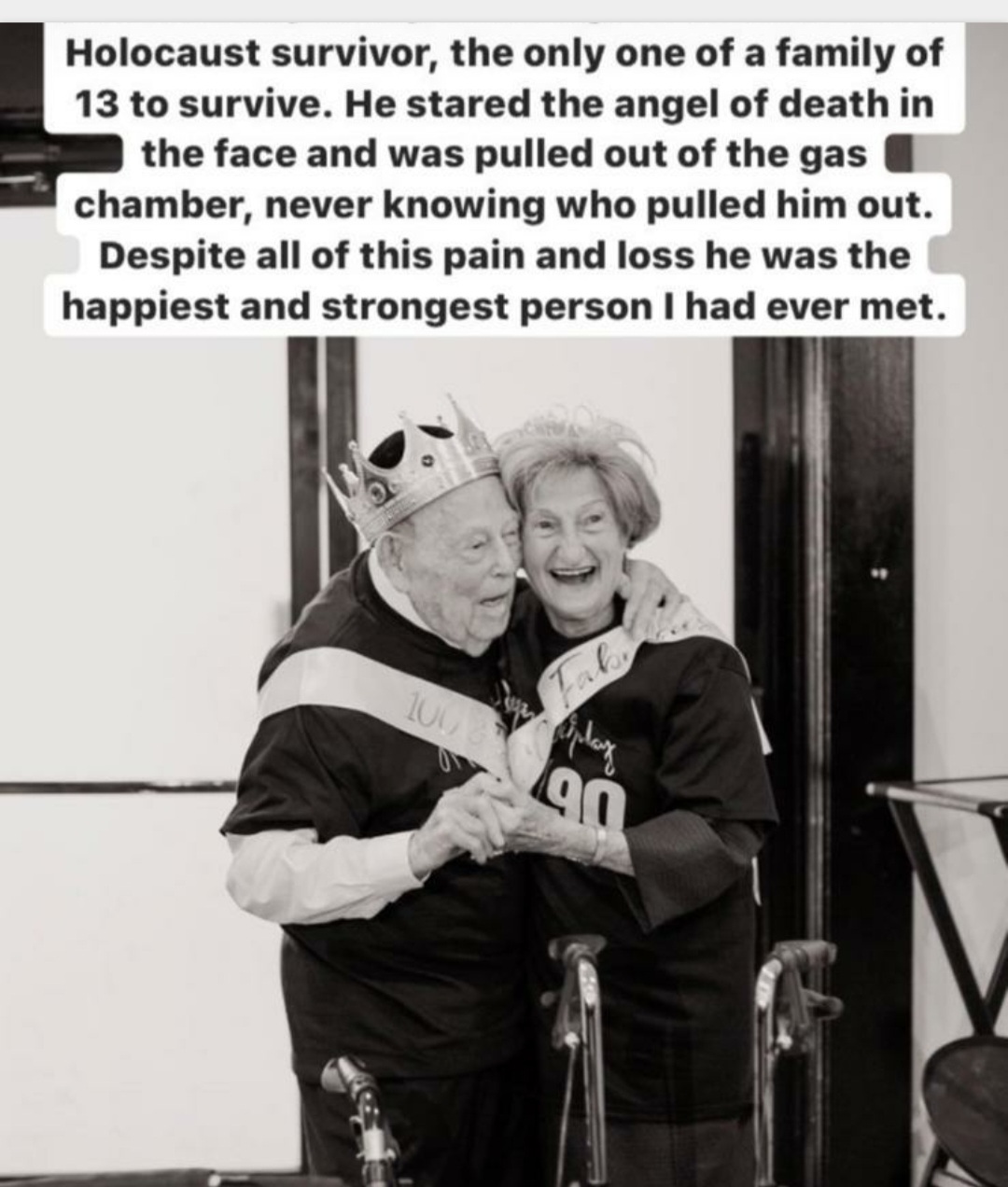
Many years ago my Aunt Esther Friedman became a widow. A few years later she happened to meet a wonderful elderly gentleman, Chazan Yitzchok Friedman. Interestingly he had the same last name as her first husband. He was a gem of a man, always radiating simcha. Although they both suffered through the Holocaust years, they kept strong and never forgot their heritage.
Everyday for the past 50 years he has recited the entire Tehillim. Unbelievable and very special indeed.
Believe it or not these two elderly people decided to get married, against both their families advice. It was a very shocking shidduch. He in his mid eighties and she in her mid seventies. Despite their advanced age, the couple felt they were made for each other and wanted to spend the rest of their years together. They could not be discouraged.
I remember being honored with a Brocho under their Chuppah. It was an interesting wedding to say the least.
Now it is almost fifteen years later and they are still happily married. Who would have ever thought. He is almost 100 years old and she is almost 90 years old, both going strong, living together at home. It is a true inspiration to watch them interact and take care of each other, with the greatest respect. From where do people get such courage and inner strength to keep on going without reservation? No doubt they have a tremendous Simchas Hachaim with loads of Emunah and Bitochon. They are unstoppable and live it daily. What an example and legacy they are leaving to be emulated.
When we are connected to Hashem,  the unimaginable, the impossible happens. Who ever dreamt they would survive and live together so long. No doubt Hashem saw how much they valued life and appreciated everyday. They didn’t take anything for granted. They cherished time and with that brought Simcha to their families. Never did they loose sight of how precious each day was that Hashem was giving them. They were rewarded with healthy long years. May we merit the same, to serve Hashem with appreciation and most important, Simcha.

LAST WEEKS IN NYU

In 1988 my father was hospitalized in the NYU intensive care unit. A few months before he passed away I brought the Rosh Hayeshiva Horav Chaim Pinchus Scheinberg to visit him.
They were very close, going back to the Chofetz Chaim days of 1945. He even officiated at my parents wedding in 1949.
I felt it would be a chizuk for the entire family to meet the Rosh Hayeshiva and for him to give us guidance during this trying time. I remember bringing the Rosh Hayeshiva into the Intensive Care Unit, where my father lay comatose. Needless to say the Rosh Hayeshiva was emotionally moved by all that was happening to one of his favorite old talmidim. He called out to him, letting him know he was there. Standing  by his bed he started to Daven fervently, crying to Hashem for for a miracle. All of a sudden, miraculously my father partially awoke, opened his teary eyes and made it known that he was aware of the Rosh Hayeshivas presence.
After returning to the lobby my mother turned to the Rosh Hayeshiva and asked him, how long we were supposed to allow our father to suffer. At that time the Rosh Hayeshiva happened to be carrying with him the Sefer Titz Eliezer. He opened it to the section dealing with this particular question and showed us inside that we were  required to allow time to take its course and not interfere with Hashems ultimate plan. As hard as it was for us to digest this psak, we followed his sagely advice. My father continued to live for another few months until he was nifter totally purified Erev Shabbos Kodesh.
Surrendering to Hashem’s will in difficult situations as this,
is the real test. Living the understanding, that life is totally in Hashem’s hands, is the challenge. That He gives life and takes life back on His timetable is a reality we all must face. Cherishing every single moment, enables us to have a greater appreciation for the life Hashem grants us daily. We always must thank Hashem for our past life and daven for a future life that will allow us to serve Him in good health.

Orchestrating Our Lives

Hashem is always orchestrating our lives. Not always do we merit to notice it right away, let alone feel it. When we do, it’s a special moment. If only we would take some time out, to contemplate and review our comings and goings and what happens to us throughout our day, everyday. Surely we would have a greater appreciation for the role Hashem plays in our lives constantly.

So here I am in the airport with my wife, waiting to fly back to the USA. Usually we reserve two window seats, one behind the other. This trip however, we were seperated due to unforeseen circumstances. My wife was assigned a window seat on one side of the plane and I, an aisle seat on the other side of the plane.
As we were ready to board, the woman standing in front of me called out to her friend, “I wish I didn’t have to sit by the window. I always have an aisle seat”. I was taken aback by her sudden announcement and quickly turned to her and said, “I would be happy to change seats with you. You have the seat I want and I have the seat you want”. After we both agreed to make the switch and exchanged seat numbers, we were in for another surprise. Our original assigned seats were next to each other. Her window seat was 46L and my aisle seat was 46F.  We were separated by only two seats.
Now what are the chances of something like this happening?  Two people out of four hundred boarding a plane, exactly the same time, each one needing the others seat, which happened to be in the same row. I could have been a minute behind her or a minute in front of her and would never have heard her announcement. The timing was perfect. Hashem sent exactly what we both wanted, exactly when we needed it. What a humbling experience, to actually feel and witness Hashem’s intervention. He knew what we needed and took care of it all, for us. Literally putting our desired seats at our disposal, in the knick of time.
Only one thing I could do after that. Thank Hashem for holding my hand and for letting me know in real time, that He was holding my hand, looking out for my benefit. Thank you, thank you, thank you, is all I could think of. Appreciating that Hashem let me know, that I am not alone in this world and that He is beside me all the time, looking out for my best interest.

Burial On Har Hazeysim

It has been my custom, to travel to Eretz Yisroel every year, to honor the memories of my parents, at their resting places on Har Hazeysim, for Tefillos and Kaddish.

It happened one year that the Chevre Kaddishe were not available as usual, due to unexpected funerals, occupying most of their day. Since they knew I traveled from the USA, specially for this occassion, they went out of their way to try and accommodate me. I would have to meet them at the Shamgar Funeral Chapel in Geula. Go up with them to Har Hazeysim late in the afternoon for their last burial, to be followed by a visit to my parents kevorim. So it happened, I met them at Shamgar together with a nephew. Upon our arrival they told us to get into their van. So we sat down opposite each other on the benches running alongside the van and waited. All of a sudden they arrived with a stretcher and  without notice, pushed the nifter right in between the two rows where we were sitting. The Yerusalmie Chevre Kaddishe members then piled in alongside of us. This was surely not what we Americans were used to or prepared for. During the drive up to Har Hazeysim the members discussed how special the elderly nifter from Russia was.They said he had been confined to a labor camp and miraculously survived, although he was forced to work seven days a week. That one Shabbos he decided, come what may, he would not allow anyone to force him to desecrate the Shabbos. To insure he would follow through on his commitment, he intentionally poured hot water over his hands. With this Meseras Nefesh he disqualified himself from working. My nephew and I were beyond ourselves upon listening to this story. It sent chills up our spines. Hashem had put us in this place, at this specific time, in order for us to hear the story about this great humble Jew. He actually fullfilled the commandment of serving Hashem בכל נפשך, with his entire being, in the fullest sense of the word, sacrificing his health and welfare for Hashem. What a privilege it was for us to have had the opportunity to partake in his burial and to be part of the minyin that gave him his last deserved honored rights. Truthfully speaking, this hidden great should have had thousands of people at his funeral. Sometimes Hashem’s beloved are out of sight and mind. It is this type of sacrifice that has sustained the Jewish People throughout the  generations.
Weeks later, after returning to the states, my wife and I dined at a Flatbush restaurant one evening. There by chance we
met Rabbi Zecharye Wallerstein and shared this experience with him. He was very moved by that Russian Jews מסירת נפש to keep Shabbos and went on to share a similar story, that he personally experienced.
He was asked to attend the funeral of a מת מצוה, an elderly Russian Jew who had passed away, without leaving family behind, besides his wife. Just a little more then a minyin showed up to his funeral. Looking around the crowd it became clear that there was no one to eulogize the departed man. No children in sight. Seeing this, the wife stood up and said, “I wish to eulogize my husband myself”. She started out, by relating the following story. “Shortly after our marriage in Russia we were separated due to communist turmoil and persecution. When we were finally reunited, we were impoverished. There was  no means of purification and nowhere to go”. She then raised her voice and tearfully said, “I can testify on this man that lies here before us, that he never  put a finger on me all the years we lived together. Only after we were liberated, were we able to resume normal family life. At that point however it was too late to have children”. Hard enough to imagine, let alone believe, that is what he shared, and actully witnessed. There was no way to ever know about this righteous Jew. It was a secret, that only his righteous wife knew, now revealed by her for the first time.
How fortunate are we to belong to such a great exalted nation, that contains such hidden Tzadikim. Their great sacrifices, purely for Hashem’s sake, no doubt create great merits for our nation, that helps us survive.
After looking back and reviewing the sequence of events, it all makes sense. First, winding up in a Chevre Kaddishe van, under very uncomfortable circumstances.Then to merit  hearing first hand the unbelievable story of the intentional hand burning sacrifice and to unexpectedly take part in this great Jew’s funeral. Then to hear another incredible story about the funeral of another holy Russian Jew. It can be said, that the
days hardships were all worth it, just to be able to experience and later share their encouraging unknown stories. May we find the added strength, to also serve Hashem uncompromisingly, even when it isn’t so convenient and in trying circumstances.
Was thinking, if they could pass their tests with flying colors and do the things they did, then what excuse do we have, not to do Hashem’s will with all our might and conviction, even when it’s hard and perhaps unpleasant.
May we all merit to really serve Hashem with all our hearts and soul.

Nicklesburg Encounter

Woodburn, New York is home to the famous Nicklesburg Shul. In the summer months, day or night, it’s the sure place to find a Minyin, a smile and a free snack. When the small bungalow colony I reside in has no weekday morning Minyin, I daven in Nicklesburg. Try to be on time. When you have a scheduled meeting with the king, its not a good idea to be late. After all, it only takes a little better time management to be on time. Very easy to be judgmental when we see people walking in late. Doubt,

that is what Hashem wants of us. There is only one real judge in this world and that is Hashem. He has all the facts. We don’t. We only see outwardly, but never truly know the whole story. Therefore, we have no license to judge other people’s actions. Instead we are advised by our Sages to judge people favorably and to give them the benefit of the doubt. Not an easy perspective to live by. Its a life’s work. Admittedly it can be very challenging at times.
I was fortunate to learn this lesson, clearly, first hand. Thankful to Hashem that he allowed me the experience in real time.
So here I was one morning davening in Nikelsburg. The חזן was holding right before ברכו, when a young man whom I recognized, took a seat right in front of me. He hastily put on his Tallis and Tefillin and tried to catch up to the Minyin, fast track. Before davening was over, he was already unraveling his Tefillin and putting his Tallis away. He recognized me and perceived that I was amazed by his quick dialog with Hashem. Last in and first out? Somewhat ashamed he turned to me and said, I know my conduct  appears strange. Want you to know that my wife is sick in the hospital. I just managed to run away for a few minutes in order to catch a ברכו and קדושה, under very trying circumstances.
Wow, here was a Jew who strained himself to come to Shul that morning with absolute מסירת נפש. He could have taken the easy way out and daven by the כותל in his room. Instead he put forth tremendous effort to come to shul for as long as possible. Who was I to judge? How easy it would have been to misjudge. You never know the whole story. Even after you think you do, you probably don’t. How wonderful life would be for all of us, if we could only train ourselves not to be judgemental. To give other people the benefit of the doubt, as we would like those people to do for us.

The Chair Lift

In the late 1950’s I traveled through the Canadian Rocky Mountains with my parents and siblings. Still remember the snow capped mountains and  magnificent beauty Hashem created. My father was traveling through populated Jewish cities in Canada, stopping to deliver inspiring speeches to benefit Yeshivas Chofetz Chaim. During these travels he took time off to spend with the family. One day we went to a chairlift, that would cross between two magnificent mountain tips, passing over beautiful valleys and streams. Each open chairlift was attached to an overhead in motion pulley with one long steel bar, that seated two passengers.The plan was for my father and I to take the first chair lift and my mother and sisters to follow in the next. On the launching platform we waited for our turn. We were advised, that when the next chairlift passed by, we should quickly take our seats and that an attendant would  manually lock a hand rail bar around us for security. My father and I took off without a hitch but unfortunately the attendant missed locking the bar in place around my mother and sisters. Imagine being suspended in an open chairlift thousands of feet above the ground, unsecured. With one hand my mother held on to my baby sister and with her other hand she held on to my sister sitting beside her. You can just imagine the fear that gripped my father when he turned around and became aware of the dangerous situation my mother was in, helpless to do anything. Needless to say my mother was panic stricken.That they didn’t fall off the chairlift while in motion was nothing less than a miracle. It could only have been an Angel of Hashem that protected them. Since the chairlift company took pictures, the scene was photographed. After everyone’s safe arrival, my father bought the picture, in order to remember the miracle Hashem granted his family.

During our lifetime we all go through challenges and close calls. Its just part of life’s journey. At those times we need to remember Dovid Hamelech’s words, “לא אירא רע  כי אתה עמדי” “I do not fear, for you are with me”. It is important to know, that Hashem has provided every Jew with a security detail of four angels, that are always guarding him. My mother was an Auswitz survivor, who had experienced and dealth with some of the most horrific trials and tribulations one can imagine. She was a confident  courageous woman, prepared for every eventuality. No doubt Hashem orchestrated this challenge and test. Surely He wanted to hear my fathers and mothers prayers during those terrifying moments, when there was nothing to rely on but Him. Sometimes that is the reason why Hashem puts us through difficult challenges. In order to elevate and bring us closer to Him. To make us understand, that everything that happens in life is a result of His orchestration, thereby strengthening our trust and faith in Him. Sometimes he puts us in a situation where we must totally surrender to Him. It is during those trying moments that our hearts truly open up and our pure heartfelt prayers pierce the heavens. It allows us to connect to Hashem in ways unimaginable before. Never is a Jew to despair. “הטוב”, Hashem the essence of good, always has something in mind, to help create a better us for the future.

A Rabbi & A Father

When the Prophet Eliyahu ascended to heaven in a fiery chariot, his student Elisha called out, “Father, Father, Chariot of Israel”.

The question is; Why didn’t Elisha call out, Rabbi, Rabbi?

The answer may be, that his Rabbi treated him more like a father then a student. To Elisha, the father portion of the relationship resonated more than the Rabbi portion of the relationship.

Not always does one have the privilege to find a Rabbi that he can also call father.
In the summer of 1971, I arrived in Eretz Yisroel for the first time, to study Torah under the guidance of the great Goan & Tzaddik HoRav Chaim Pinchos Scheinberg. In those days it was difficult for parents to send their children across the globe to study Torah.There were no cell phones, fax machines or email. Just making a regular phone call, was a challenge. It required operator assistance, dealing with different time zones and a hefty expense. A phone line connection had to be scheduled in advance and established between the two parties in two different parts of the world. It could take hours. Therefore communication was generally through letter writing. Consequently, the separation family felt then, was real. For my parents to send away their only son, was an extra special sacrifice. Only because the Rosh Hayeshiva guaranteed  them, that he would take care of me like his own son did they agree to send me off.
Arrived in Eretz Yisroel right before Tishe B’Av, in order to have ample time to prepare for the upcoming Elul Zman. For  young American boys, to acclimate to Eretz Yisroel living, in those days required real adjustment. It was a relatively new undeveloped country, still recuperating from three recent wars. Life was very different from that in the USA, let alone the language barrier, culture shock and change of environment.
The Yeshiva had just moved in to its new building, located
in the developing Kiryat Mattersdorf neighborhood in Yerushaliyim. Even before I had a chance to fully acclimate to the limited food, water quality, mountain air and straw mattress,Tishe B’Av had arrived. Needless to say, reciting Kinnus for the first time in Yerushaliyim was very inspiring. In the morning after davening, while exiting the main study hall, I fainted. The bochurim quickly carried me to my room two floors below, while someone ran to tell the Rosh Hayeshiva that I had suddenly taken ill. It didn’t take long before the Rosh Hayeshiva was sitting at my bedside, feeding me a teaspoon of whiskey with a biscuit less than a kezaiye’s every nine minutes. Till he was satisfied, I was recovering he stayed with me. He did not place the task on anyone else. The Rosh Hayeshiva cared for me like a father to a son, just as he promised my parents he would do. Not just then, but throughout the next 50 years, even after my parents passed on, the Rosh Hayeshiva was always concerned for me and my families welfare.

Years later when the Rosh Hayeshiva was already in his late nineties, he would stay in my home while visiting the USA, to raise funds for the yeshiva. I had the unique privilege of paying him back for the spoon feeding care he gave me when I was young, by spoon feeding him, now that he was to old to eat himself. He always gave of himself and likewise now, it was his chance to receive in return.
In Hashem’s world no good deed is overlooked. Hashem makes sure that what goes around, comes around,מדה כנגד מדה.

Bitul Ayin Horah

The Jewish people, time  immemorable, have always tried to avoid an Ayin Hora, the Evil Eye. Our Sages have advised, stay out of the public eye, as much as possible. Drawing attention to oneself is not recommended. The less people can talk about us, the better it is for us. Needless chatter and being in the limelight can cause “not fargining” and envy. That sets the stage for the evil eye to take hold. Our Sages have also warned us time and again, not to make other people the subject of our conversations. We may Chas V’sholom cause a friend, unwillingly, hardships and mishaps. Instead of being happy for someone who is successful, as we always should be, at times we may be resentful, jealous and even judgemental. Does he or she really deserve that kind of success? Why not me? What follows is Ayin Horah. Therefore it is wise, to avoid being the center of attention and topic of discussion. Best not to give people reason to mind our business and talk about our lives. Sometimes, its just unavoidable, out of our control and difficult to stop. Regrettably, that is what happened to my family many years ago.

Was renovating a house I had recently purchased for my growing family. For some reason, unbeknownst to me, it became the talk of the block, although nothing unusual was taking place. What followed was devastating. Shortly after  moving in everyone started to get sick. Throughout the first year, my wife, children and I wound up in the hospital, for no apparent reason. It made no sense. After consultation I was told that most likely we were effected by an Ayin Hora. Was very troubled by this revelation and phenomenon. Asked Rabbonim if they knew someone of Holy statuer that could eradicate an Ayin Hora. Unfortunately they could not point me in the right direction. At the time I was a Rebbe in Yeshivas Karlin Stolin. One day I went over to the renowned Rav Meyer Pilchick z”l and explained my dilemma. He looked concerned and said, I know just the right Jew who can help you. Needless to say, I was relieved to hear, that there was someone out there that could be of assistance. Asked him who that Rabbi may be. He said, his father, the humble Rav Nissim Pilchik z”l. He then went about arranging a time for me to meet with his father to remove the Ayin Horah. One morning I arrived at Rav Nissim’s home. He asked me to share with him everything I and my family had been going through. He then handed me a Special Sefer and told me to recite certain prayers in one room, while he would simultaneously recite some other prayers in a different room. After we completed our recitals, he told me, to go to the synagogue, to light candles at the Omid and to give charity. He assured me that my family would no longer suffer from the evil eye that had been hovering over us the past year.
So it came to pass, our lives returned to normal and continued uneventful.
Many years later, I merited to stumble upon his grave site in Tiberias by Divine Providence. What a privilege it was to offer up prayers at his gravesite and to have the merit of repaying him in some small way for his kindness.
What goes around, comes around. He had prayed for me and my family and now it was my turn to pray for him.

How careful we must be from chattering about other peoples lives and successes. Our Sages teach, that real blessing takes hold only on things that are hidden from the eye. By minding someone else’s business instead of our own, we can unconsciously cause a person and his family harm. When we don’t fargin and believe we deserve what the other person has been granted, we invite the Evil Eye. A Jew that trusts and believes in Hashem, that all resonates from Him, must always be happy with his or her lot. We must know that we can never have what is destined for someone else. Whatever Hashem blessed someone else with was meant for them. If it was meant for us, Hashem would have blessed us with it also. Hashem has enough to go around. We can never have what was not meant for us and we can never take away from someone else what was meant for them. When we know deep down that Hashem is the exclusive Giver and that there is no other power besides Him, our eyes, hopes and prayers will be focused heavenward, only looking up to our One and Only  beloved father.
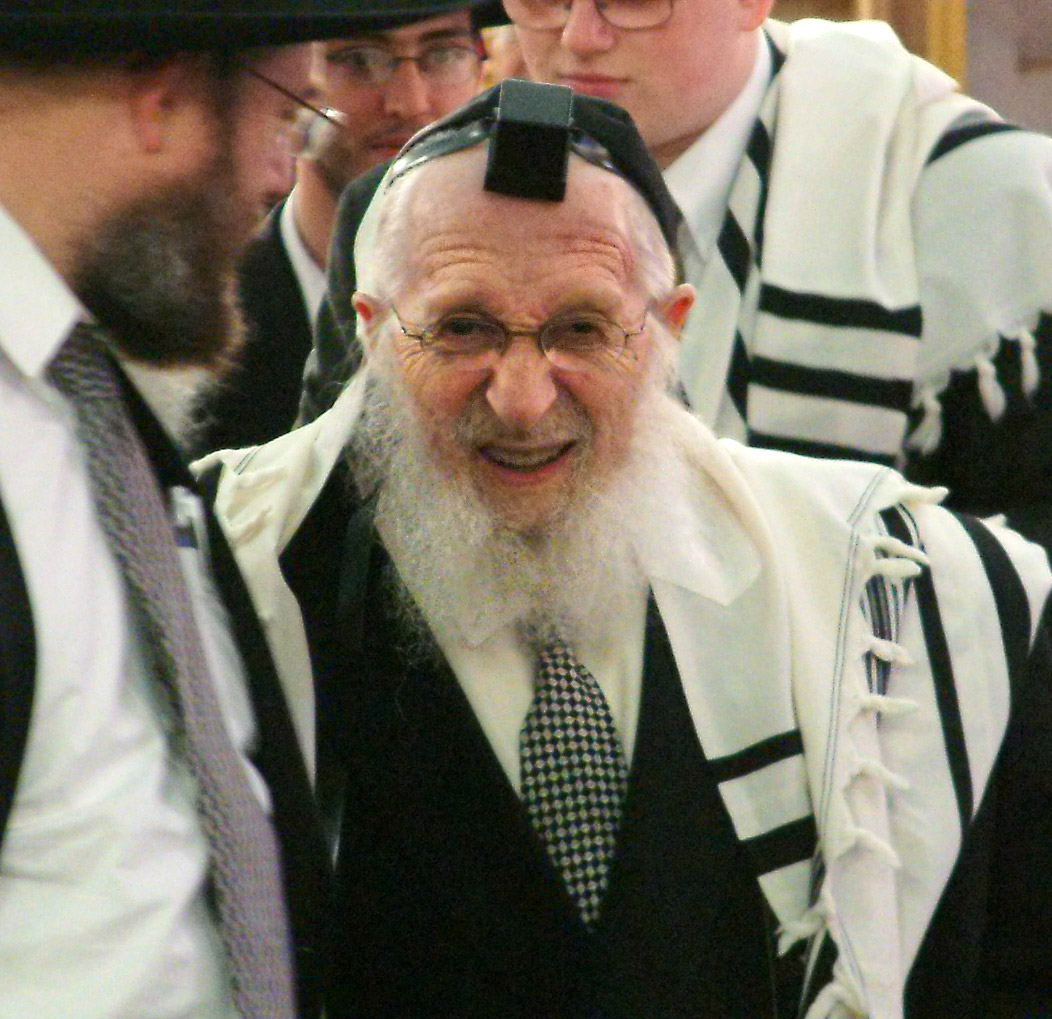
The Torah Hitch

My father HoRav Pinchos Singer z”l was a very kindhearted, giving person, constantly doing Chesed  and always trying to foster peace and tranquility amongst people. He made it a point to always look for the good in everyone’s actions. No matter how challenging the situation was, he would somehow dig up a zechus. Nothing would make him more happier than to shower people with kindness, tell them a good vort and make them smile.

One morning as we were driving past 13th Ave and 48th Street in Boro Park, a Yid stopped us and asked for a hitch. We invited him into our car and asked him where he was going. He said 18th Avenue. That was one block out of our way, since we lived on 17th Avenue and 51st Street. Having to go to 18th Avenue would also mean getting tied up in traffic. As the car approached 17th Avenue, I  turned my blinker on, in preparation to make a right turn and to drop our passenger off on the corner. At that moment my father said, don’t turn. Go straight to 18th Ave and take the Yid to his final destination. He explained afterwards, that there are two types of Chesed. There is common Chesed which we regularly do and then there is Torah Chesed. Common Chesed is when you do someone a favor that does not inconvenience you. For instance, giving someone a hitch, when you are headed in the same direction they are. Not doing that kind of Chesed  would be sinful, since you are going there anyways. Torah Chesed takes on a whole new dimension. It is going out of your way to do someone a favor, even if it not convenient.  That shows you really care. It is not just about what you do, but more importantly, how you do it. It is not just about giving charity but how you give the charity. It is not just about helping someone but rather the demeanor in which you provide the help. How you smile while you are helping. It is going the extra mile that matters most. That was the precious lesson my father of blessed memory taught me that everlasting morning. Get out of your comfort zone and do the Chesed with all your hearth and soul.

It’s A Good Kashe

As a young boy I had the good fortune of living near to the great Goan  HoRav Eleizer Kersner zt”l, distinguished Rov of the Bnei Yehuda Shul in Boro Park. He was an acclaimed scholar and sage par excellence, from “The Alter Heim”, who basically knew everything there was to know. He strictly lived by the principles and etiquette of the old country. As a warm, concerned, caring person he befriended me, a youngster growing up on the streets of Brooklyn in the early sixties. Since my father and I davened in his shul Shabbos night, the Rov took an interest in my progress and developed a close relationship with me.
One day I came home from yeshiva with a question that perturbed me. Naturally I went to the Rov’s home to share my dilemma with him. He thought for a moment and said “Yankele, doz iz a gutte kashe” this is a good question. Needless to say I was pleased to hear that. “Ein minutkele, ein minutkele” one minute, just one minute the elderly Rov said, as he took a moment to think of an answer. He then took a ladder, braced it against one of the bookcases lining his dining room walls, climbed up, stretched his hand out high and pulled out an old sefer from the very top shelf. He climbed back down, blew off the dust, placed the sefer on the table, flipped some pages and then called me over pointing to a specific spot on the page and said smilelingly, “here Yankele is the answer to your question”. Can you imagine! There must have been hundreds of seforim in his library and he knew exactly, which sefer dealth with the question, where the sefer was located amongst all the other seforim, what page to turn to and the exact spot on the page where the answer was discussed. Unbelievable. As a youngster it was difficult to fully appreciate the giant in who’s company I merited to be. Looking back now, I am humbled to have had the great opportunity of being exposed to one of the great Goanim of yesteryear. Wish I would have taken a little more advantage of the relationship. We should never underestimate the greatness of those who teach us Torah. Their wisdom and knowledge only came through great toil and effort. One day we will look back in time and say to ourselves how lucky we were to have known that great Rosh Hayeshiva. Let us make sure today that we won’t have to say tomorrow “If only I would have taken more advantage of the relationship I had in hand. Take advantage today. Cherish the moment.

Ready To Be Shamed For Torah

Will never forget my beloved Rebbe, HaGoan HaTazdik HoRav Chaim Pinchos Scheinberg zt”l. He excelled in all areas. The true embodiment of Torah and a living life example to all. What stood out most, was his love for Torah and those who studied it. He would sacrifice his health and total being to no end in his efforts to insure its continuity. His honor meant nothing when it came to preserving the Torah’s honor.
He lived in Yerushaliyim and had the custom of coming to the United States every Pesach, to spend time with his family and raise money for his Yeshiva. On Chol Hamoed the Rosh Hayeshiva would dedicate one full morning to make appeals at all minyonim taking place in the renowned Sefardeshe Shul in Boro Park. Between the many minyomin going on all morning, he would sit in a small room off to the side and learn, till he was called upon. Wasting time didn’t exist by him. Every moment was precious. By the time all minyonim ended at approximately midday, the Rosh Hayeshiva was totally exhausted, having davened himself at sunrise. It was my honor to drive him afterwards to Monsey. It always bothered me, how such an elderly acclaimed Godol demeaned his stature yearly in such a way. Since we were close, I mustered the confidence and asked, Rebbe, how much did you raise this morning. Surprisingly he answered $1000.00. Rebbe, if I raise the money for you, would you please stop doing it yourself? Its disrespectful to you and the yeshiva. No he said. A Yid has to be willing to be Moser Nefesh and shame himself for the sake and honor of Torah. His answer no doubt shocked me. Wow. The Rosh Hayeshiva continued to do just that for many years thereafter. His love for Torah and his yeshiva was boundless. He honored them by exerting himself on their behalf.
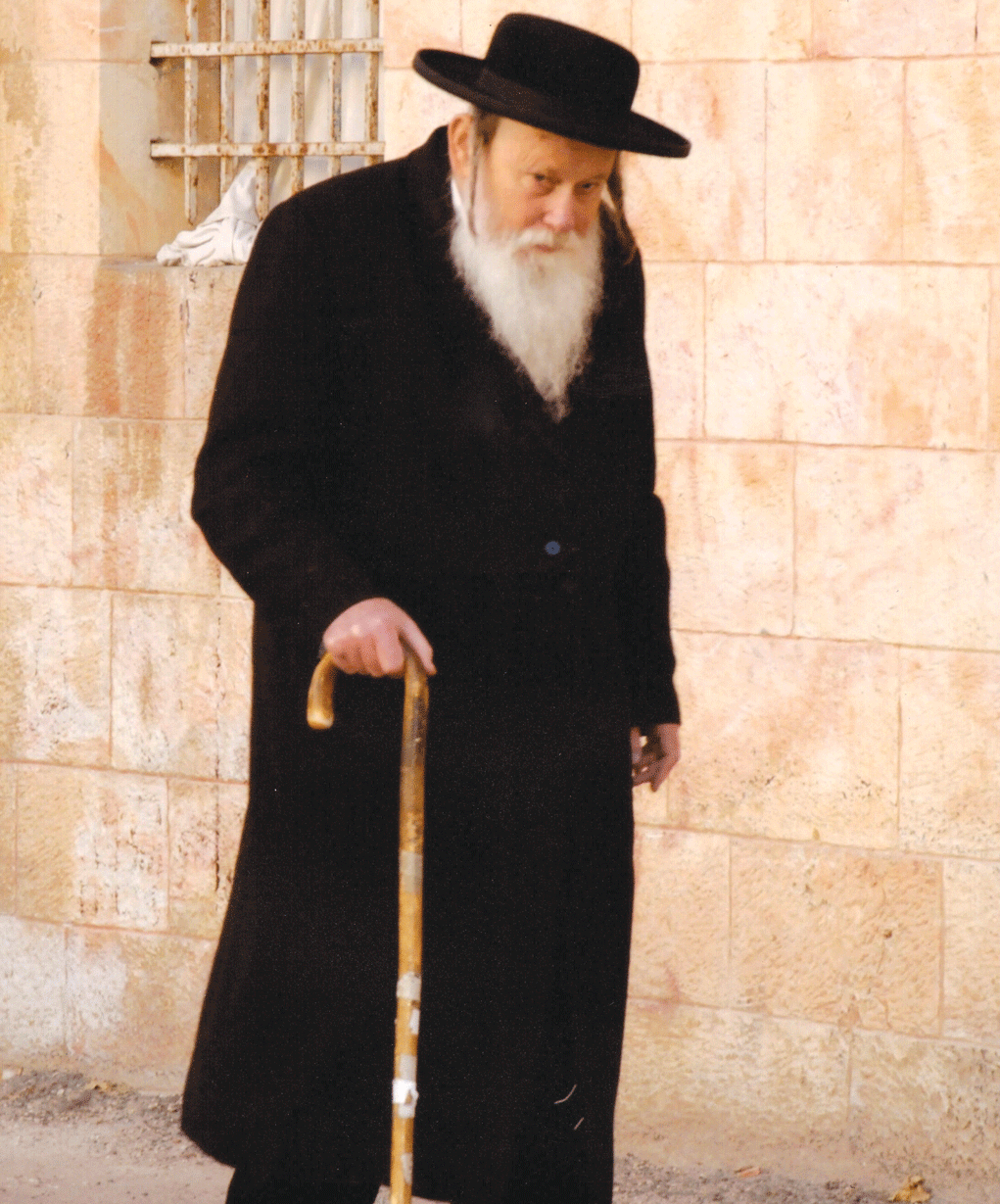

Golfing in Georgia

Being a Rebbi and supporting a family in the early 1980s was not easy. Many colleagues, myself included, needed to supplement our incomes after classes to survive. Being paid little and late, didn’t allow for peaceful survival. My colleague and I decided one day after teaching, to travel to New York  City and explore supplemental income possibilities at a Hardware Trade Show. It was our good fortune, to discover a new product invented by NASA, that we felt was worth pursuing. I alone decided to purchase a franchise and went about marketing the product, which ultimately helped make ends meet. Years went by and through Hashem’s benevolence the business developed and expanded.

One day I had the good fortune of being introduced to some successful business people, by my representatives in Atlanta, Georgia.They were interested in meeting up, but only on the golf course. This no doubt presented a real challenge, since I was totally unfamiliar with the sport. Never was on a golf course, let alone knowing how to properly hold and swing a golf club. But as the saying goes, what doesn’t one do, to provide for their family? So I consented meeting the buyers on their terms. Quickly learned about the sport, borrowed some golf clubs and learned how to swing. I was now set to go. The day before the meeting I flew out to Atlanta. To my good fortune the suitcase arrived but the golf clubs did not. Really not wanting to golf, I took advantage of the situation and told my representatives who were there to pick me up, that without my own golf clubs it would be difficult to golf properly. They assured me they would locate the golf clubs in time for tomorrows outing and whisked me off to the hotel I had arranged close to the orthodox Jewish community. Really was very apprehensive all along discussing business in that environment. Out of respect to the reps however I had no choice but to comply with their wishes. They found the golf clubs and happily brought them to the hotel, looking forward to the following days important meeting. In the evening I sincerely davened to Hashem to somehow make it possible for me to do the business without having to golf with the businessmen. Imagine the anxiety of never having golfed before and having to pretend. Believe it or not, the next morning brought relief. My prayers were answered. Overnight the weather had taken a turn for the worse and a storm broke out and soaked the entire golf course. Understandably it was impossible to golf under those wet muddy conditions. When the reps came to pick me up the following morning, they couldn’t stop excusing themselves about how sorry they were, that the golfing wouldn’t work out after all the preparations that were made.They were sorry on the outside and I was relieved,  happy and grateful to Hashem on the inside. We had the meeting in business attire in a regular office setting and Boruch Hashem the outcome was successful.

The lesson is clear, Hashem is in charge and in full control of our sustenance and destiny. “man plans and God laughs”. Hashem decided on Rosh Hashana what the sustenance would be for that year and just rolled out his plan according to his will. He truly saw how disinterested I was in transacting business on the golf course and made sure to spare me the experience. The Talmud teaches us that according to the way man wants to go, so is he led. I wanted to go to Atlanta, but not to the golf course and Hashem orchestrated it just that way. Hashem is always looking out for our best interest.

The Telzer Rosh Hayeshivas Shas

It was 1964 when my parents z”l sent  me away from Brooklyn, to study Torah in Telz Yeshiva. Needless to say it was a tremendous sacrifice for them to send away their only 13 year old son, after having survived the Holocust and losing most of their families. They however weren’t ready to take any chances of having their son grow up amongst the gentile population that lived in Boro Park at the time. It was their prayer and hope that up on the secluded hill where the yeshiva was located in Wickliffe, Ohio, surrounded by great Roshei Yeshiva and Torah scholars, their son would develop into a Torah true Jew. All my teenage years were luckily spent in that environment. After graduating high school my father unfortunatley got very sick. I needed to find a way to support myself while in yeshiva. Fortunately an opportunity  presented itself where I was able to secure the monopoly of all binding rights in the yeshiva. Every Thursday evening, anyone who needed their seforim bound would bring them to a designated room in the dormitory. Depending on the condition of the sefer, a repair charge would be  established.

One evening the Rosh Hayeshiva Horav Mordechi Gifter showed up and asked if I could repair his Shas. He had the old golden Shas with the padded cover. It was in shambles and looked very used. I told the Rosh Hayeshiva, it would be my pleasure to try and repair it, but that it would be a big job due to the condition it was in and would take some time. He graciously consented to the terms and price. After weeks of hard work it was finally restored. Was witness to how much hard work must have probably gone into ruining the Shas. The untold thousands of  hours the Rosh Hayeshiva must have spent toiling and trying to understand every word and nuance contained in each page. The sleepless nights he must have spent preparing his magnificent  shiurim.

Will never forget, how happy he was when I returned the Shas to him. He looked it over and then said to me with a big smile, “Yankel, du host mir geratevit mein shas” Yankel, you saved my Shas. He was so overjoyed that all the pages of his precious Shas came together again.

The joy experienced and merit felt at having brought the Rosh Hayesiva this happinnes by restoring his precious Shas will remain with me forever.

Meeting the Tzadik Rav Zundel Kroizer ztl

In  2007 my wife and I traveled to Yerushaliyim to spend Succos with our youngest newlywed couple. During our visit we decided to meet with the Tzadik Horav Zundel Kroizer, at his very humble dwelling in Botei Brode, to receive his brocho. It was a very spiritually uplifting experience. Just to be in his presence was a moment to cherish. While there it became apparent that he was surviving on the very bare minimum. Before departing I offered him some money. He refused to take it. “I only accept money to hand out to the  poor” he said. Basically what he needed for his own livelihood didn’t count. What was given to him, he gave to other poor people, so they  could live. In his eyes he was not important at all and certainly not needy.

As we were leaving I noticed piles of new seforim in a book case off to the side and asked Rav Zundel if he authored them. “Yes” was his reply. “Can I purchase a sefer”? “Yes”. Short answers. No extra words. “How much does this sefer cost?” “Thirty five shekels”. I pulled out  a $50 bill, worth 250 shekels at the time and gave it to him. My hope was that through the purchase he would wind up keeping some money for himself. I was in for a big surprise. He refused to take it and said, “it is forbidden for me to accept more money then the actual selling price value of the sefer. However if I say to him, “לדידי שוה לי” to me the purchase price is worth it, then he would  accept it. I complied with his wishes and he accepted the money. Fearing that he would give it away, I said to him, “the Rebbe also needs to live”. What he answered now was truly shocking. “קמך יש לי, תורה אין לי”. Flour I have, Torah I don’t have”. He lacks for nothing and needs nothing. The only thing he thirst for is additional Torah knowledge. Mind you he was clear and fluent in all the revealed and hidden areas of Torah. Due to his extreme humbleness, he didn’t consider himself knowledgeable or worthy of anything more then what was absolutely required for his daily existence.

How fortunate we were to have the merit to stand in the presence of such greatness, a true Eved Hashem, permeated through and through with holiness, piety and purity.יהי זכרו ברוך.

Zeidy Marries Third Time

Will never forget when my grandfather HoRav Alter Yitzchok Izik Friedman zt”l married for the third time. The year was 1978. He already was 80 years old at the time. You can well imagine how reluctant everyone in the family was, about him  remarrying again. He however insisted and married Gittele in the presence of the Skulener Rebbe. Remember the Rebbe being delayed to the chasunah. The Kallah an old lady herself, refusing to go to the Chupah until the Rebbe arrived and was able to be Mesader Kedushin. It was a pretty interesting wedding to say the least. Watching Choson and Kallah sitting next to each other and the grandchildren dancing in front of them. It was a sight to behold.

Since I was very close with my grandfather, I asked him  when the opportunity presented itself, why he decided to marry a third time.“It’s strange Zeidy, but older people like you generally don’t get married a third time, especially at such an advanced age. Why did you?” What he answered, left an everlasting impression. His words and the lesson he  taught me then, still rings loud in my ears. “Az meleibt ahlein vert min selfish”. If you live alone you become selfish.

Life’s main purpose is to share and to give. My Zeidy remarried again just to make sure that he would not become selfish in his old age. He needed to live with someone in order to ensure that he would have with whom to share and to whom to give. What a holy marriage that was.

Unexpected Wedding Invitation

One day a wedding invitation arrived at my home, sent by Rabbi Avrohom Bleich, a Rov in Michigan. He was an old beloved talmid of mine, whom I hadn’t seen for some 35 years. He was marrying off a child in Brooklyn, and invited me to the wedding. Not so easy to respond yes to every wedding invitation that arrives and to attend. After all, traveling from Lakewood to Brooklyn, round trip is time consuming. Two weeks passed and then one day I received a phone call. It was non other then Rabbi Bleich himself, personally reaching out and inviting me. He said it would mean very much to him to see me attend. That I had touched his life in many positive ways and that he had fond memories.Thought to myself, if a Talmid went through all the effort to uncover his old Rebbie’s whereabouts, he deserved my attendance. Little did I know at the start of the trip, how rewarding and special the evening would turn out be. Upon entering the wedding hall, he noticed my arrival and immediately took me into the center to dance with him alone. A while later the choson joined the circle followed by the mechutin. Took one look at him and realized he was also a talmid. Two talmidim were meshadich together. Soon after another few men suddenly joined our dance circle and realized they were also talmidim, all from the same class. How special that was, to be dancing together with a half dozen talmidim, after being separated 35 years.

How did this all come together? A talmid went the extra mile. A Rebbie went the extra mile. Surely Hashem looked down upon us and admired the love he saw between a talmid and his Rebbie and rewarded the effort with a mini reunion. Touch a persons hearth and inspire him. The love you create will last a lifetime.

The Forgotten Raincoat

It was a rainy Shabbos. My raincoat accompanied me to and from shul throughout the day. Motzei Shabbos I left shul after Maariv and headed to the parking lot. Upon entering the car I remembered that I forgot to take my raincoat. Was perturbed at the moment, but decided not to go back to retrieve it from the coatroom. The following morning I attended a Shuir in shul. After the Shuir, upon existing the building I was greeted by a heavy downpour and unable to get to my car. My dilemma  was soon solved. I  remembered the rain coat  forgotten the night before. You can imagine the relief. Now I appreciated the fact that the raincoat was forgotten the previous night.

Nothing is by chance. Should I get soaked for attending a shuir? Hashem orchestrated everything the night before, in order for me to have a raincoat the following morning. We never know while things are happening why they are happening. Sooner or later, if we remain patient, we find out. All that transpires is Hashem’s blessing in disguise. Whatever happens, significant or insignificant, is to be looked upon that its for the best. כל דעבד רחמנא לטב עבד

Torn Retina

There are times in our lives that only after an experience or difficult challenge, do we realize Hashem’s Divine Providence, mercy and guidance. During the challenge we don’t always stop, think and appreciate Hashem’s hidden intervention.
Was looking for an experienced, top notch ophthalmologist. My friend recommend one in Manhattan. Made an appointment for my wife and myself, scheduled three months out. Asked for an earlier visit, but was informed that no openings were available. Was advised that if there would be a cancellation the office would contact me.
A month later, while in Brooklyn, ready to leave back home Thursday afternoon I received a call that there was a last minute cancelation and the the doctor was available that evening. First reaction was not to take the appointment since my wife and I needed to get back to Lakewood to help prepare for our grandson’s Bris the following morning. In the end my wife returned to Lakewood herself, while I chose for some unknown reason at the time to accept the appointment and headed to Manhattan myself. Something told me not to pass up the opportunity. Was expecting an uneventful  examination and new prescription. That was not to be. After the examination, doctor all of a sudden left the room without saying a word, returning fifteen minutes later, very concerned. Doctor informed me that serious tears in the retina were discovered, that required emergency surgery. It was scheduled for the following morning, 11:00 AM in Manhattan. I told doctor that my grandson’s Bris was scheduled to take place in Lakewood, New Jersey the following morning and this early appointment would create undo hardship. Doctor responded, I arranged for a specialized surgeon to come in to take care of you. You are at great risk of loosing sight in your eye if its not taken care of first thing tomorrow.
You can just imagine the shock. Quickly returned to Lakewood and shared the news with my family. Overnight an unexpected snowstorm broke out. In the morning the roads were full of snow. Very concerned, how would I ever arrive for the surgery on time. Right after davening, the Bris was held quickly and soon after before the seudah left with my son to Manhattan. To our surprise, the snowstorm kept everyone off the road creating a no traffic situation. A trip that regularly should have taken two hours only took an hour and fifteen minutes. Got to the Upper West Side just in time. Everything, Boruch Hashem worked out for the best. Reflecting back I said to myself, how really we are not in control, as we would like to think. Was planning on returning with my wife to Lakewood early, but that didn’t  happen. Hashem had other plans, without even consulting me first.
Imagine, if that other patient hadn’t canceled their appointment that Thursday afternoon. Imagine, what could of happened if I would have returned with my wife to Lakewood, instead of taking the last minute appointment and going to Manhattan alone. Imagine, if the doctor would not have discovered the torn retina for which ironically I had no symptoms. Imagine, if the doctor was not able to arrange a surgeon to take care of me immediately. Imagine, if the snowstorm didn’t break out Thursday night, how much everyday traffic I would have encountered.
What I thought that morning  to be an added challenge, really turned out to be a blessing in disguise.
We all go through challenges in life. While we are going through them, we do not always realize that there is a higher power orchestrating everything behind the scenes for a better end result. Sometimes we find out about it early on and sometimes only later on in life.
In this experience all the events that transpired were for the ultimate benefit, unbeknownst at the time. Everything Hashem does is for the best. We may not see it or understand it immediately while things are happening, but sooner or later Hashem reveals His plan and kindness to us, that He was behind it all.
In this situation, Hashem sent the Refuah first. Not having any idea of what was going on, Hashem was looking out for me every step of the way. How wondrous and mysterious are His ways.

The Parking Space

We are taught that every person’s income for the upcoming year is decided by Hashem. It is firmly Established every Rosh Hashana. No one, no matter how hard they try, no matter how hard they work and no matter how much money they earn, at the end of the year, after all incomes and expenses are tallied, they will only wind up with their preordained portion.

Had a parking space to rent out in January. A gentleman called one evening and asked to rent it. Desperate he offered a high rental, since finding parking in this area was very difficult. Unfortunate for him, his call had come in too late. The space was already rented out and had to turn him down. He asked to please record his name, phone number and rental offer for future reference. Six months later in June a new parking space became available. Went back to my notes to find his contact information. Was surprised to find that everything was recorded except his phone number. Called 411 and succeeded in obtaining his home number. Called morning and evening for two days, even left messages, but no one picked up or returned the call. With only three days left to the beginning of the new rental month, I went back to my call log from January and started calling all the other people that had inquired about the parking space when I originally advertised it. Some people said they were interested but not ready to commit. Continued to randomly call other numbers in the log. Finally after many unanswered phone calls, a gentleman answered. After briefly speaking to him he committed to rent the space. Happy that the deal was sealed just in time, I asked for his name. It’s hard to believe that the gentleman I was now speaking to was none other then the same gentleman I was trying to reach for the last two days on a different number. Now I had reached him unintentionally on his cell phone in Eretz Yisroel, which happened to be one of the many numbers in my old call log from which I was randomly dialing. When I mentioned that I had left a message, he responded that he was presently in Eretz Yisroel and was not able to retrieve his home phone messages.

It was Hashem’s will that I reach him, just then, late in the evening Israel time, right before he was ready to retire for the night on a different number.

Hashem insured that he would get the parking space he desperately needed and that I would get the premium rental offered back in January. Hashem was looking out for both of us and brought us together in a most improbable way, on His clock. We each received what was written for both of us on Rosh Hashanah. A match made in heaven. Hashem is constantly looking out for us more than we can ever imagine.

Blessing of Rav Nosson Tzvi

In the year 2009 my wife and I traveled to Eretz Yisroel to spend Succos with our children. They were  married a few years and still childless. Needless to say these were trying times for our entire family. Everyone was davening, giving tzedakah and begging Hashem for a yeshuah.
During Chol Hamoed we all went to visit Rav Nosson Tzvi and his Rebbetzin. We all sat down in his Succo and spoke for a while. In the course of our conversation, I took the opportunity to share with him a spiritual kavona that came to me one day, as I was davening for my children in Shimonei Esrey. The Rosh Hayeshiva listened intently and said with much feeling and emotion, “Mit ah zeliche kavonos darf der eibershter mekabel zein de tefelois”. With such thoughts Hashem MUST accept the prayers. He reassured us that Hashem would help. And so it was, a year later, the following Succos my wife and I once again traveled to Eretz Yisroel to celebrate the birth of a grand daughter. You can just imagine the simcha of the Rosh Hayeshiva and Rebbetzin, of the new parents and grandparents. There are no words to express how grateful we all were for Hashem’s gift and unending kindness.
We can never make light of the brocho of an Odom Godol or the prayer of a simple man. Hashem is ALWAYS listening to our hearts. If we are sincere enough, He may bless us with the gift we have been waiting for. Have faith and never stop praying truthfully.

Impressions We Leave

The impressions we leave unconsciously, may be take away lessons to an observer of an event. They may influence the viewer for a lifetime and we may never know it.

In the late sixties my parents drove from Brooklyn, New York  to Telz Yeshiva in Wickliffe, Ohio to see me. My roomate witnessed their special love and caring interaction  throughout their visit.

After Beis Medrish we both moved on in life, lost contact, got married, raised families and had grandchildren. Then one day, fifty years later my roomate happened to meet me by chance at a wedding. We reminisced, and then during our conversation he reminded me of the impression my parents had left upon him fifty years earlier .

He told me “I don’t know if you realize, but your parents were very devoted to you. You were very special in their eyes.
Did you ever hear of the organization, Priority One? That’s what you were to them”. His words touched my heart deeply.
I couldn’t believe what my ears were hearing.
It’s to marvel how their short visit had such an influence on a young teenage boy, who was just observing from afar a parents interaction with their son. My old friend still remembered them now, although a span of fifty years had passed. They stood out in his mind and left an everlasting impression on him that he never forgot, although he had been through tens of thousands of experiences since then. Wow.
This is the kind of impression we can leave on people young and old through our exalted actions and words, that can last a lifetime.
Was thinking, how careful we must be in all our interactions with people. You never know who’s watching or listening. The impressions we leave may impact a life forever.

Saying Birchas Hamazon from a Siddur

We are always encouraged to recite Birchas Hamozon from a Siddur. It is not always easy to do, especially when we are in a rush.  To stop then, take a Siddur, sit down and say each word slowly can be very challenging.

One particular morning I found myself racing the clock. After Mayim Achronim I quicky sat down to bench.  With no Siddur at hand it was very tempting to just bentch by heart. Nevertheless I got up once again to fetch a Siddur. Back at the table I rushed to open it and there right before my eyes was Birchas Hamozon.

Didn’t have  to spend  time flipping through pages to find the correct place. Had it, first try. At that moment it became very clear that the extra effort was recognized by Hashem and He gave me  the correct place immediately. This is an example of what the Sages teach, “according the way a man chooses to go,” Hashem leads him”.

It is amazing to observe how Hashem is in touch with our every intention and gets involved in every minute detail of our life, second by second. It is important to take note of these occurrences and to know that everything we think about doing and everything we eventually do is noticed. Hashem does not miss a beat.

These incidents, when we are cognizant of them need to be recorded in our psyche. They can serve as constant encouragement to make us really feel  that Hashem is with us all the time. We are never alone. What we think may be very minute  and unnoticed is noticed.

Nothing we do in the service of Hashem is to be discounted. Everything is valuable, every effort. No matter how small we may consider it to be, it is appreciated by Hashem. Many times He shows it to us immediately.